
Shooting Pain in My Head, Is It a Brain Problem? | Incheon Occipital Neuralgia

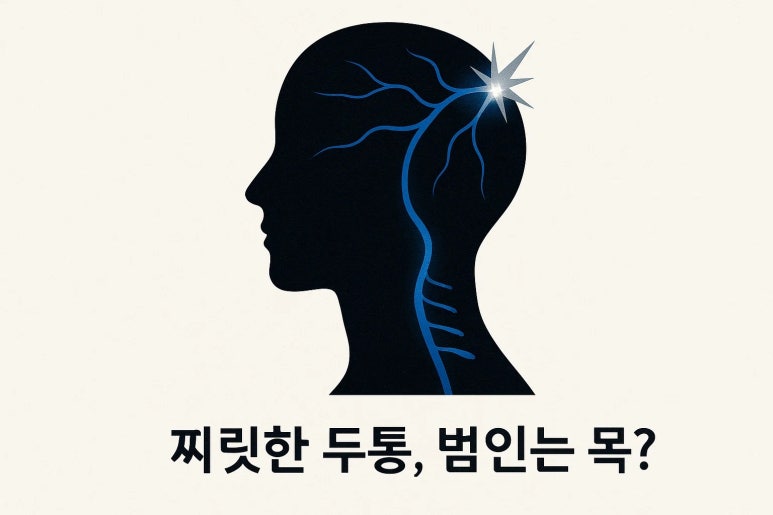
Sharp, Zapping Head Pain – A Brain Issue? The Culprit Might Be Your Neck
| "I'm just sitting still, and suddenly my head feels like it's being poked with an ice pick. It only lasts for a few seconds, but I'm terrified that I might have a serious brain condition." |
This unpleasant pain often strikes those in their mid-40s, a prime working age. The sensations of 'zapping' or 'electric shocks' fill us with dread. This is due to an intuition that it's somehow different from a typical headache. But before jumping to premature conclusions, there's something important to consider: the true origin of that pain might not be your 'brain'.
| [Key Considerations] If it were a serious condition like a cerebrovascular issue, it would likely be accompanied by other neurological symptoms in addition to the zapping sensation, such as limb paralysis, slurred speech, severe dizziness, or visual disturbances. If you only experience momentary zapping sensations without these 'red flag' symptoms, then we need to turn our attention to the neck. |
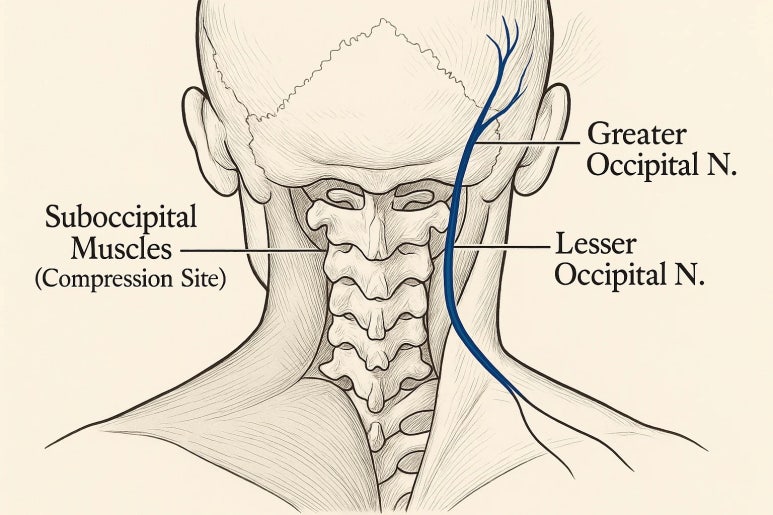
This situation is like 'a circuit breaker tripping in an apartment building'. When the lights in a room flicker, we first suspect an issue with the circuit breaker or wiring, rather than the light fixture itself. The same applies to the sensations in our head. There's a nerve that acts as a 'wire' to the scalp, and that is the 'occipital nerve'. This nerve originates not from the brain but from the upper cervical vertebrae (neck bones), piercing through the dense muscles in the back of the neck to supply sensation to the scalp at the back of the head and the crown.
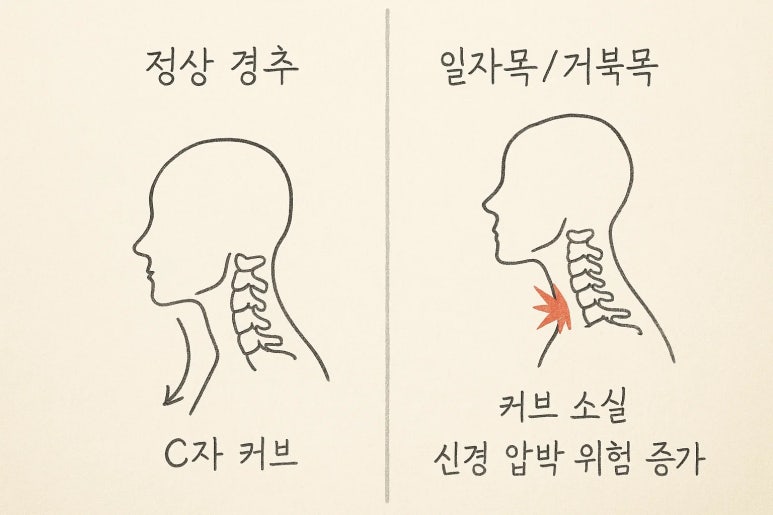
| [CASE STUDY] This is the case of Mr. P, a 45-year-old programmer who spends long hours coding in front of a monitor. For years, he had attributed his `sharp, zapping head pain` symptoms to 'migraines'. However, his pain worsened on days when his neck felt particularly stiff. An X-ray of his cervical spine clearly showed `straight neck` (loss of the normal C-curve). It turned out to be symptoms of `occipital neuralgia`. |
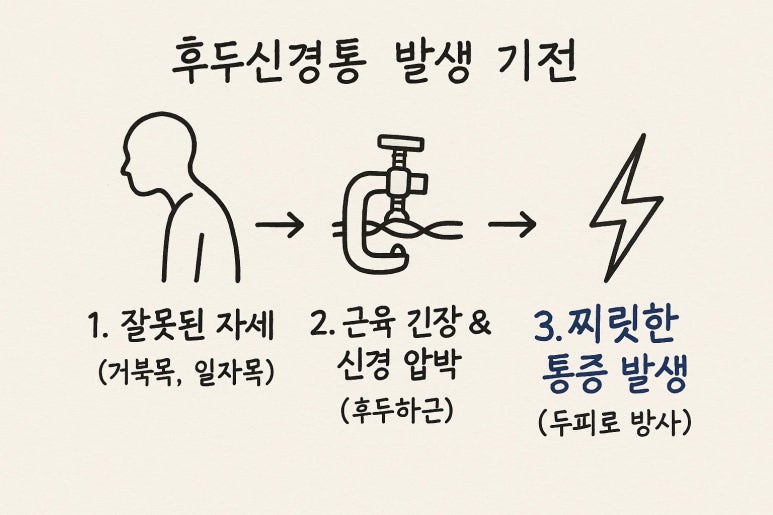
When a `straight neck` or forward head posture (tech neck) is maintained for long periods, the muscles connecting the neck and head (especially the suboccipital muscles) become excessively tense. These taut muscles then compress the occipital nerve passing through them, causing inflammation of the nerve. The compressed nerve malfunctions, sending `zapping` pain signals to the scalp, as if an electric current were passing through. Thus, the true cause of `scalp pain` was, in fact, the neck.
Prolonged computer work → Entrenchment of forward head posture → Excessive tension in posterior neck muscles → Onset of occipital nerve compression → Occurrence of intermittent zapping sensations → Chronicization of symptoms.
| [Note: Traditional Korean Medicine Perspective] In Traditional Korean Medicine (TKM), this type of pain is viewed as an issue with the 'Taiyang Meridian' (太陽經). The Taiyang Meridian is the largest meridian governing the back of the neck and the entire head. It is explained that when harmful energies like 'Wind-Cold' (風寒) obstruct the circulation within this meridian, the flow of Qi and Blood (氣血) becomes stagnant, leading to sharp, piercing pain. This perspective aligns with the modern medical explanation where muscle stiffness hinders nerve and blood circulation. |
| [Finding a Solution] So, how can we break this cycle of zapping pain? Anti-inflammatory painkillers can help temporarily relieve inflammation, but they are not a fundamental solution. The key to `cervicogenic headache treatment` is addressing the structural causes that compress the nerves. Adjusting your monitor height and performing `neck stretches` once an hour to release tense muscles. These can be the most important and effective first steps to root out the problem. |