
Throbbing Pain Behind the Eye: Ophthalmologist or Neurologist?

When You Feel a Throbbing Pain Behind Your Eye, Should You See an Ophthalmologist or a Neurologist?
| "The ache and throbbing are so intense I feel like pulling out my right eyeball and washing it. My vision also seems to have gotten worse, and I'm worried this might lead to a serious illness." |
This kind of pain felt behind the eye, known as 'retro-orbital pain,' makes many people anxious. Due to the pain's location, people naturally assume it's an eye problem and visit an ophthalmologist, but the test results often come back 'normal.'
| [CASE] Mr./Ms. K, a working professional in their 30s, visited various ophthalmology clinics for several months, undergoing repeated dry eye treatments and intraocular pressure tests, but the pain did not improve. |
If no specific abnormality is found in ophthalmological examinations, we need to change our perspective. The possibility is that the culprit might not be the eye, but the 'brain.'
| [Refuting Clue] While severe eye pain can indeed occur in cases where intraocular pressure rapidly rises, such as in acute glaucoma, this is usually accompanied by clear 'visual abnormality signals' like hyperemia, rainbow halos, or sudden severe vision loss. If only pain recurs without these symptoms, the problem is likely elsewhere. |
This situation is like 'a fire alarm going off.' The alarm location is the 'eye,' but the actual ignition point of the fire could be the 'brain.' The sensations of our brain and facial region are connected via a massive neural highway called the 'trigeminal nerve.' When a migraine occurs, the trigeminal nerve endings around the brain's blood vessels are stimulated. This signal travels along the highway to the area around the eye, causing pain as if there were a problem with the eye itself. This is called 'referred pain.'
So, how can we suspect that this is migrainous pain? The decisive clue lies in 'accompanying symptoms beyond just pain.'
| "When my eyes start hurting, I feel nauseous, and it's hard to tolerate bright light or loud noises." |
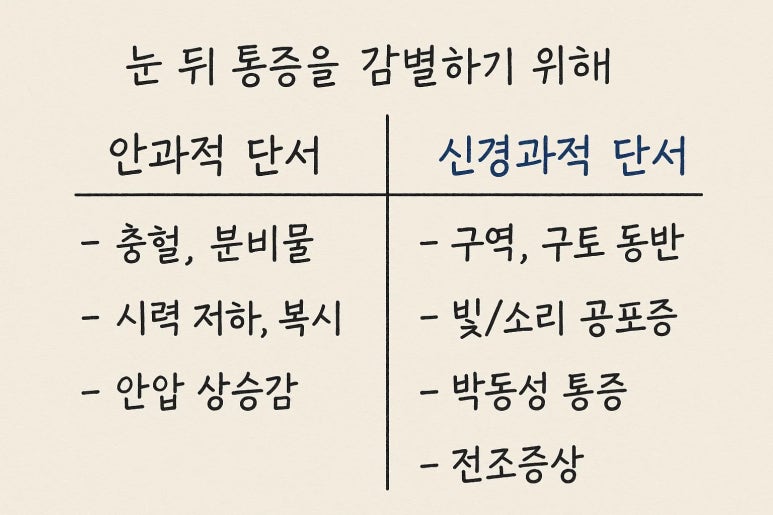
These are typical characteristics of migraine. If it were solely an eye problem, there would be no reason for systemic symptoms like nausea, vomiting, photophobia, or phonophobia to appear.
Occurrence of visual aura like shimmering in front of the eyes → Pain starting behind one eye after 30 minutes → Pain worsening to a throbbing quality, accompanied by nausea → Lasting for over 4 hours, then gradually subsiding. If there is such a consistent pattern from the onset to the resolution of pain, along with accompanying symptoms, including 'migraine aura symptoms,' then migraine can be strongly suspected as the 'cause of retro-orbital pain.'
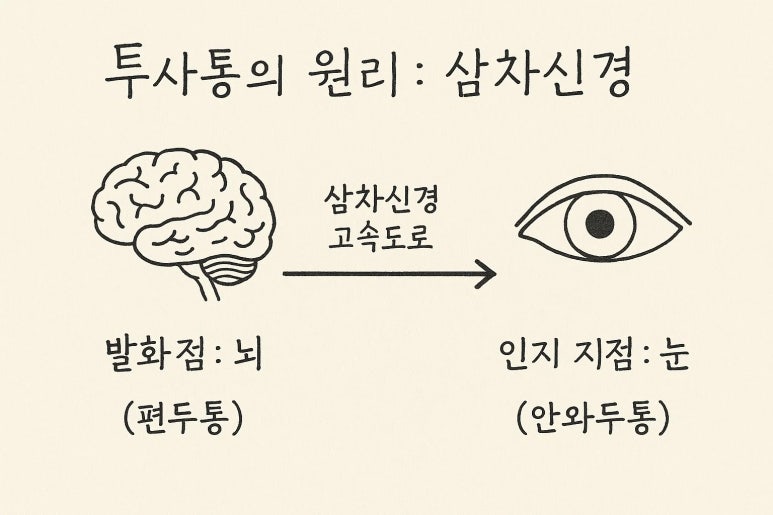
| [Reference: International Headache Society Diagnostic Criteria] According to the diagnostic criteria of the International Headache Society (IHS), migraine is defined as a neurological disorder characterized not just by headache, but by accompanying symptoms such as nausea, vomiting, photophobia, and phonophobia. Therefore, it often does not respond well to common painkillers and often only responds to triptan-class migraine-specific treatments. Even if someone complains, 'My eyeball hurts,' it might be part of 'trigeminal neuralgia symptoms.' |
| [Reference: Traditional Korean Medicine Perspective] In Traditional Korean Medicine, the function of the 'Liver (肝)' has long been considered deeply related to the eyes. It is explained that when Liver Qi becomes stagnant due to stress and 'Fire' arises, this heat rises upwards, causing pain in the eyes and head (Liver Fire Rising, 肝火上炎). This aligns with the modern medical interpretation that stress is a major trigger for migraines. |
| [New Question] If your 'pain behind the eye' is not resolved by ophthalmological consultation, it's time to change the question. Instead of asking, 'How can I relieve eye fatigue?' shifting to the question, 'What imbalance in my body is stimulating the trigeminal nerve and sending pain signals behind my eye?' will be the most important compass for finding the true cause. |