
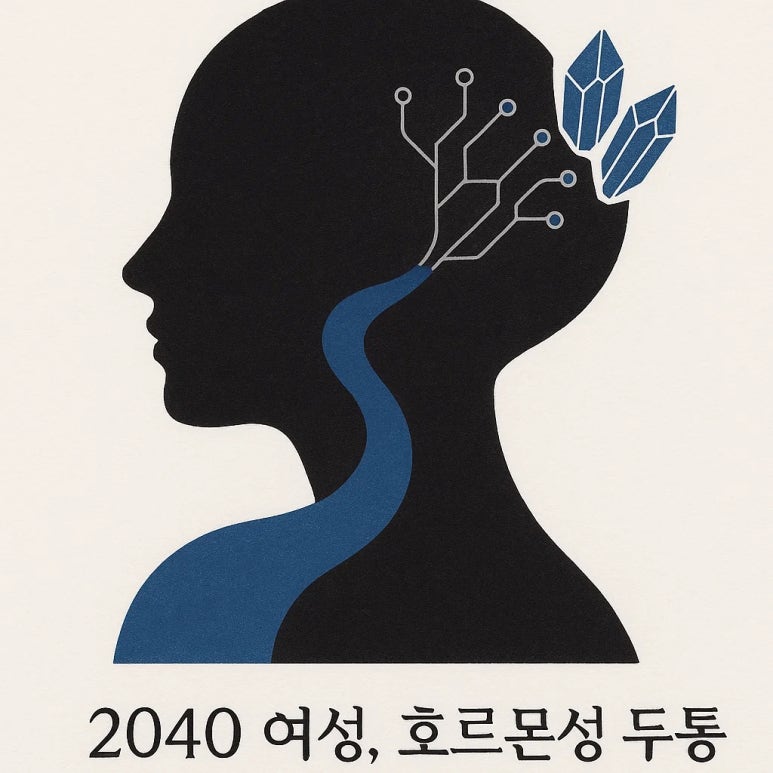
Severe Headaches Every Period: Hormonal Headaches?

Headaches Every Period: The Culprit is a Disharmony Between the Brain and Hormones
|
"My head feels like it's going to explode starting 3 days before my period, without fail. Even if I take a medicine like EZN6, it's only temporary, and now my stomach feels upset too." |
Many women suffer from headaches that appear around the same time each month. They often dismiss it as simple fatigue or stress and take one or two painkillers, but for some, it comes as excruciating pain that even those don't relieve.
|
[CASE] Ms. C, a graphic designer in her mid-30s, was one such case. She often lost focus at crucial moments due to migraines that invariably appeared at the end of the month, coinciding with important deadlines. The ibuprofen-based painkillers she regularly took as a standby medication no longer showed significant effects. |
Headaches that show a clear pattern in line with the menstrual cycle are called 'menstrual migraines' or 'hormonal headaches'. These are not merely pain issues but can be a signal from our body's intricate hormonal system.
|
[Key Clue to Watch For] If this headache were simply a muscle tension issue, it should improve with stretching or massage. However, since periodic headaches often do not respond this way, we can infer that the root of the problem lies elsewhere. |
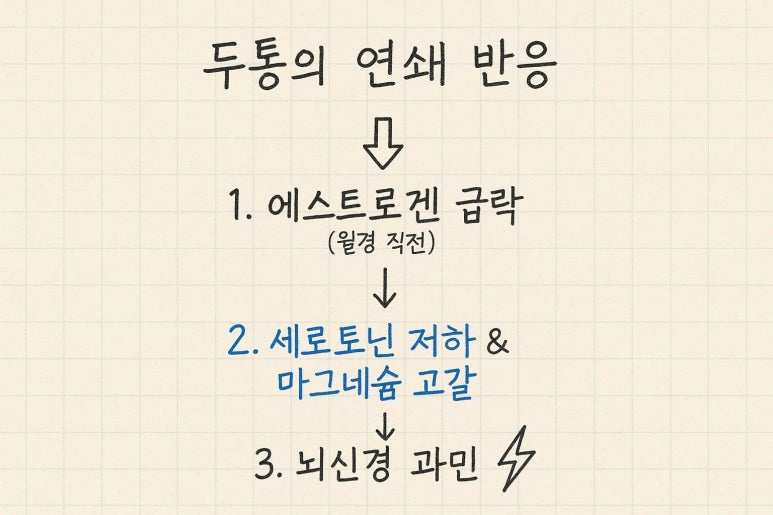
The primary suspect is the female hormone 'estrogen'. Estrogen levels, which peaked during ovulation, sharply decline just before menstruation, much like a roller coaster. This 'estrogen cliff' is what triggers the headache. Estrogen plays a crucial role in regulating the secretion of 'serotonin', often called the 'happiness hormone' in the brain. When estrogen levels drop, serotonin concentrations also decrease.
Serotonin is a neurotransmitter that plays a key role in regulating blood vessel constriction and dilation, as well as pain control. When serotonin levels decrease, cerebral blood vessels become prone to abnormal dilation, and sensitivity to pain becomes extremely heightened. This explains why the head throbs particularly intensely just before menstruation, and why patients with 'hormonal migraines' become sensitive to external stimuli like light or sound.
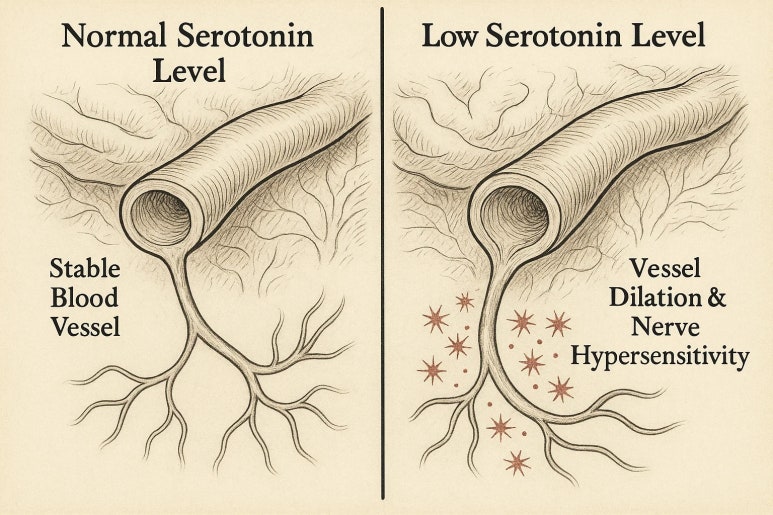
This situation is comparable to 'a broken water level control system in a dam'. Normally, the dam (brain) maintains an appropriate water level (serotonin) and stably manages pain signals, but when the key control system of estrogen falters, even a small rain (stimulus) can easily lead to a flood (headache).
There's another accomplice here: 'magnesium'. Estrogen is also involved in maintaining magnesium levels in the body, and when estrogen levels drop, magnesium absorption decreases while its excretion through urine increases. Indeed, studies show that women suffering from menstrual migraines have significantly lower intracellular magnesium levels in red blood cells than those who do not.
Magnesium is a vital mineral, often called a 'natural tranquilizer', known for calming nerve excitation and relaxing muscles. This is why headaches are cited as one symptom of magnesium deficiency. When magnesium is deficient, brain nerves become easily excitable even by minor stimuli, which further exacerbates headaches.
Ultimately, menstrual headaches are a complex outcome produced by the simultaneous action of two factors – 'serotonin deficiency' and 'magnesium deficiency' – triggered by the 'sharp drop in estrogen'. The sequence is: Estrogen sharp drop begins 3-5 days before menstruation → Serotonin decrease increases sensitivity 1-2 days later → Magnesium deficiency deepens just before menstruation begins → Severe PMS headaches occur.
|
[Note: Traditional Korean Medicine Perspective] In Traditional Korean Medicine (TKM), this phenomenon is sometimes interpreted as a type of 'Du-pung' (headwind headache) caused by 'Xue Xu' (Blood Deficiency), meaning insufficient nutrients and blood in the body failing to adequately nourish the brain. The "Dongeuibogam" states that 'when Blood is deficient, the head becomes dizzy and painful,' thereby emphasizing the importance of replenishing the body's fundamental resources rather than merely suppressing pain. |
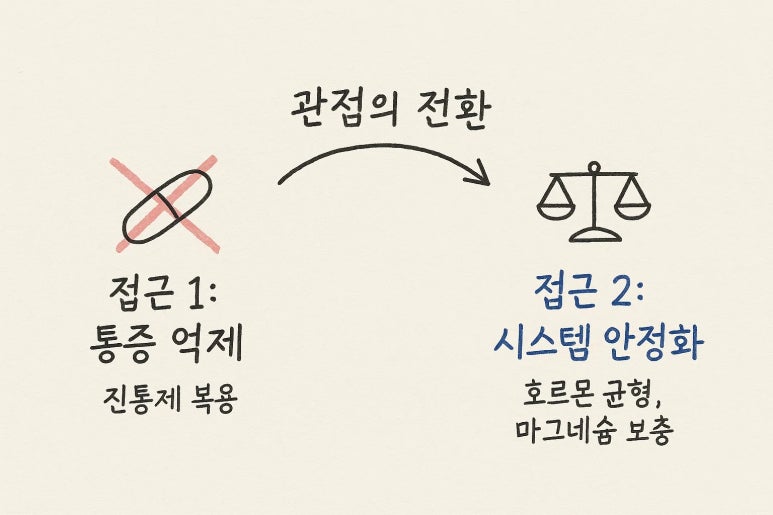
So, what can we do to break this incessant cycle of headaches? Instead of pain relief methods that solely rely on painkillers, we need to shift our perspective towards stabilizing our body's hormonal balance.
|
[A New Question] If you've understood this new perspective, the question we should be asking is no longer 'What painkiller should I take?'. Instead, we can ask more fundamental questions, such as 'What methods can I use to stabilize my neuro-hormonal system and mitigate the impact of periodic estrogen fluctuations?'. This is the true beginning of change. |