
Postpartum Depression, An Emotional Rollercoaster | Incheon Postpartum Care

| Why am I the only one who feels so weak? Many new mothers I meet in my clinic ask this very question. The joy of childbirth is fleeting, replaced by unexplained tears, postpartum depressive feelings, uncontrollable anxiety, and rollercoaster-like mood swings, leading them to blame themselves. When the world demands that mothers be 'strong,' and even family members give them a 'What's wrong with you?' look, new mothers simply end up blaming themselves for their perceived weakness. |
| To be honest, I, too, initially considered these postpartum emotional changes to be merely 'a matter of mood' or 'a temporary phenomenon.' However, through countless clinical experiences, what struck me was the realization that these complex emotions do not stem simply from individual weakness. Rather, they are a perfectly natural, yet intense, part of our body's adaptation process as it undergoes the enormous transformation of childbirth. |
So, what is the real underlying cause of these emotional changes?
Postpartum emotional changes are not simply a matter of the mind.
After listening to patients' voices in my clinic and synthesizing various clinical clues, I've concluded that three main complex factors are at play.
The first thing that comes to mind is the rapid change, like a 'storm of hormones.'
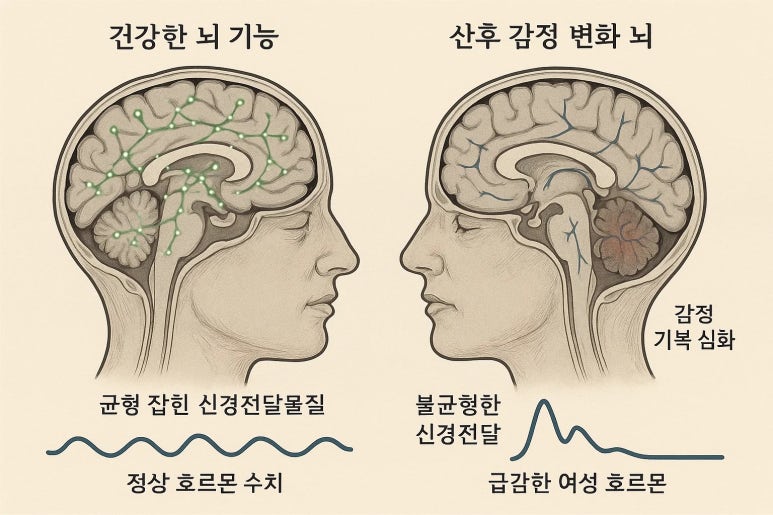
After childbirth, levels of female hormones such as estrogen and progesterone, which maintained the woman's body in a pregnant state, drop sharply. This change significantly affects the body and brain, much like an 'environment where atmospheric pressure suddenly changes,' leading to emotional instability.
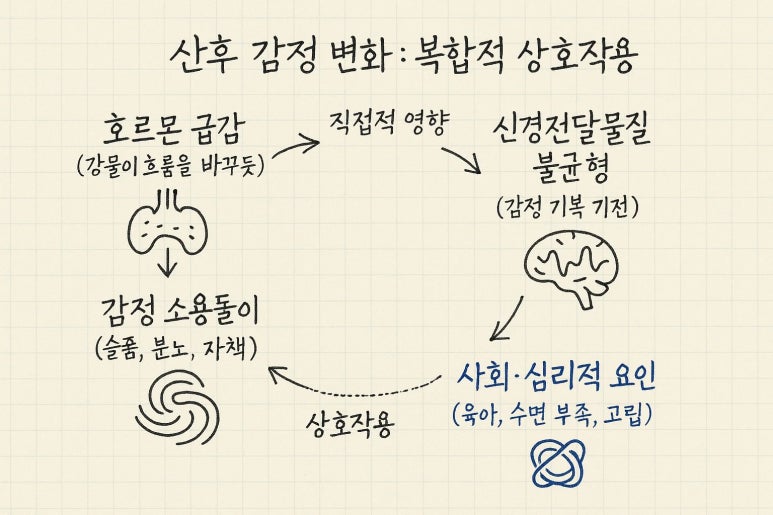
| This rapid hormonal change affects neurotransmitters in the brain, becoming a significant |
| physiological cause |
| that makes one easily feel depressive or anxious. |
Added to this is the physical recovery process after childbirth and the relentless stress of childcare.
The physical exhaustion and pain from the labor process, along with sleep deprivation, leave new mothers extremely fatigued. A baby crying all night, difficulties with breastfeeding, and the unending cycle of care contribute not only to physical exhaustion but also to significant mental pressure.
Under these circumstances, it is virtually impossible to feel calm and at peace.
As a parent myself, I know firsthand the immense fatigue brought on by sleepless nights and the unpredictable crying of a child.
Postpartum Emotional Changes: How to Understand Them and Move Towards Recovery?
I tell new mothers:
"The emotions you are feeling right now do not mean you are weak."
"They are very natural, yet difficult, signals from your body."
| Understanding this principle is where the path to recovery begins. |
Unfortunately, in many cases, there's a tendency to dismiss postpartum emotional changes as 'personal weakness that must be overcome by willpower.' However, this is a misguided perception that hinders problem-solving and further isolates the new mother.
What is needed at this time is not just encouraging words like "Cheer up," but rather appropriate support and professional intervention.
| Family members should not dismiss the new mother's emotional expressions, such as "My chest feels heavy like a stone" or "My mind is so restless I can't sit still," as mere complaints, but rather accept them as clinical clues. They should become dialogic companions who understand these patterns and work together to find solutions. |
In my clinic, I assess the body's current state of balance through various physical signals, such as the patient's pulse (脈), tongue condition, and digestion or sleep patterns, and help prescribe herbal medicine necessary for postpartum recovery.
For example, for new mothers who cannot sleep and feel anxious, I use medicinal herbs to stabilize the mind and replenish body fluids (Jinyeok), while for those with indigestion and low energy, I approach treatment by supporting gastrointestinal function and strengthening overall vitality.
| Postpartum emotional changes are a natural phenomenon resulting from complex physiological and psychological causes. If these are accurately understood, combined with warm support and professional intervention, new mothers can fully overcome these difficulties and achieve complete recovery. |
Through conversations with loved ones, sufficient rest, and sometimes professional intervention like mine, our bodies can regain balance.
| My role is to help new mothers listen to the voices of their bodies and minds, and to understand and manage their own condition as active participants in their recovery. |
Remember, this path is never walked alone.