
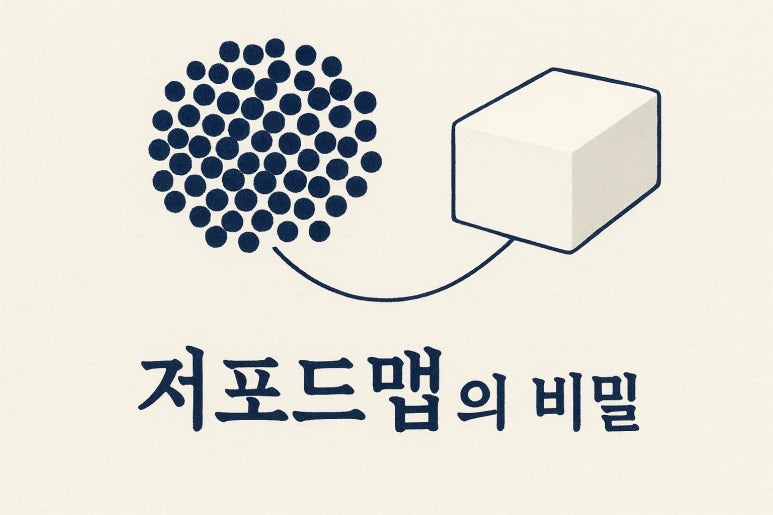
Why You Should Avoid Soybeans, But Tofu Is Fine (The Low-FODMAP Secret)

Table of Contents
|
"My stomach feels bloated when I only eat kongguksu. But tofu, made from the same soybeans, seems fine." |
|
CASE STUDY |
|
Mr./Ms. B, a professional in their 30s, reported that eating kongguksu or boiled soybeans for lunch would cause their stomach to swell firmly and lead to frequent flatulence throughout the afternoon. However, when they ate soft tofu stew (sundubu jjigae) for dinner, they felt relatively comfortable, despite it being made from the same 'soybeans'. This irony is the starting point for a common question in the low-FODMAP diet. |
Why are 'Soybeans' Difficult, but 'Tofu' Relatively Fine?
The key lies in a water-soluble carbohydrate called galactooligosaccharides (GOS). Whole soybeans are rich in GOS, which are not broken down in the small intestine and travel to the large intestine, where they become food for gut microbes. As a result, excessive fermentation occurs, which tends to increase gas and abdominal bloating. In Irritable Bowel Syndrome (IBS), this reaction becomes more pronounced, leading to the experience of 'bloating after eating soybeans'.
Conversely, during the tofu manufacturing process, soybeans are ground and mixed with water, a coagulant is used to form protein curds (tofu), and a significant portion of water-soluble components are removed along with the whey-like liquid. This means that the problematic GOS is significantly reduced, leading to a relatively lower 'fermentation burden' in the gut. Even though the raw material is the same soybean, the 'processing' changes the digestive experience.
This difference can be explained using the analogy of refined fuel. Crude oil contains many impurities, causing heavy soot, but after refinement, it becomes a fuel that burns cleanly with less exhaust.
If soybeans are 'crude oil,' then tofu is closer to 'refined fuel' with unnecessary components removed. Naturally, this analogy directly relates to the mechanism. Tofu indeed has a lower content of water-soluble FODMAPs, thus stimulating less over-fermentation by gut microbes.
'Soybeans vs. Tofu' from a Low-FODMAP Diet Perspective
The essence of the low-FODMAP diet is not to dichotomize foods into 'good' or 'bad,' but to understand the context of which components over-ferment in whose gut, and in what manner. Soybeans tend to be high in GOS, so they are often restricted during the initial elimination phase. However, tofu (especially firm tofu) is relatively low in FODMAPs, making it an option to try starting with small amounts.
|
📖 Glossary: FODMAP An acronym for Fermentable Oligo-, Di-, Monosaccharides And Polyols, referring to a group of carbohydrates that are poorly absorbed in the small intestine and readily fermented in the large intestine. GOS falls under 'Oligo' in this group. |
This interpretation extends interestingly to the perspective of traditional Korean medicine. Whole soybeans have been described as prone to creating 'dampness' (濕) and causing digestive stagnation (體氣) in the body. In contrast, tofu, through its processing, emphasizes its mild and refreshing properties, thus imposing a relatively lighter digestive burden. Modern low-FODMAP principles and traditional interpretations meet at the common ground of 'removal of water-soluble components'.
|
✅ Key Takeaways
|
|
Caution: Tofu is not 'unconditionally safe'. Products with a high ratio of water and water-soluble components, such as soy milk or silken tofu, may contain relatively more FODMAPs, and additional seasoning or processing can alter reactions. Furthermore, sensitivity varies depending on IBS subtypes (constipation-predominant/diarrhea-predominant/mixed) and the composition of gut microbiota. |
Ultimately, the goal is not a black-and-white list, but rather to interpret the fermentation process in connection with your gut condition. Try recording your reactions to 'soybeans' and 'tofu' separately in your food diary today. You will directly confirm that even with the same ingredient, the 'difference in processing' creates entirely different results in your gut.
|
Question: If you record abdominal bloating, gas, and pain on a scale of 0-10 after eating 'whole soybeans/kongguksu' and 'tofu/sundubu' respectively in your diet over the past week, what pattern do you observe? That pattern is the map guiding your next choices. |