
Musculoskeletal · Pain Oriental Medicine Clinic
Myofascial Pain Syndrome · Muscle Pain · Referred Pain· Myofascial Pain Syndrome
Incheon Songdo Baekrokdam Korean Medicine Clinic
Relieve tension in deep muscles with herbal medicine and acupuncture for chronic muscle pain and stiffness of unknown cause.
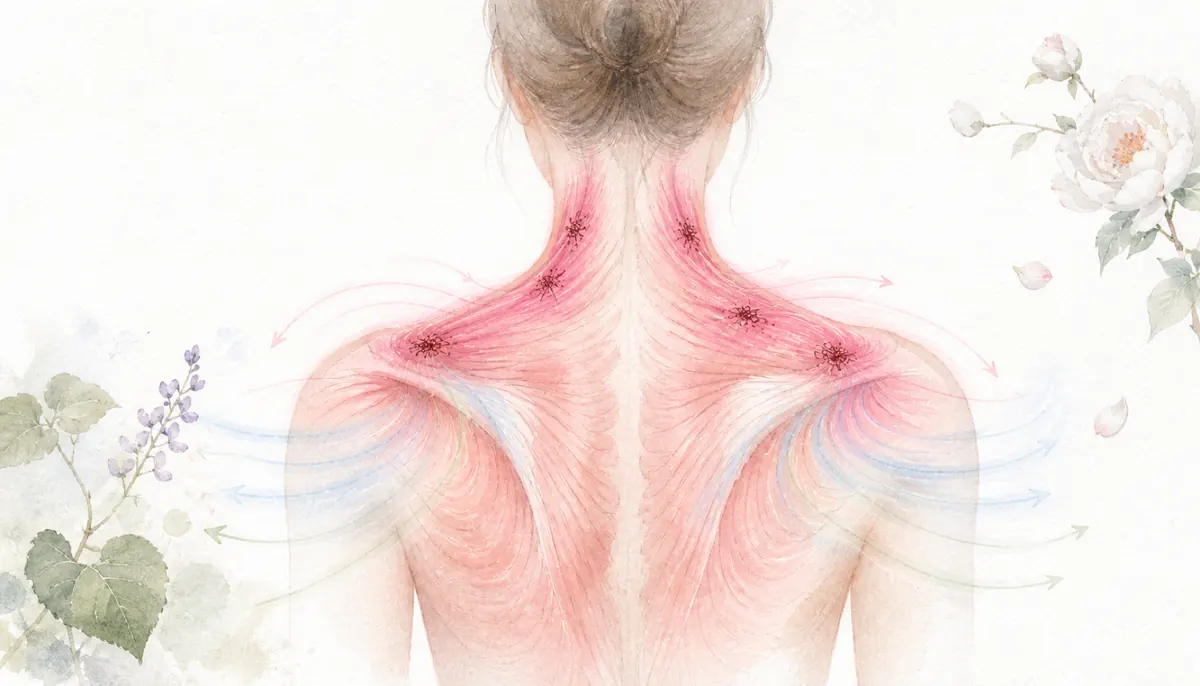
What if your X-ray is normal, but your body hurts so much you can't even breathe?It is likely not just a simple muscle knot, but 'Myofascial Pain Syndrome' where the fascia itself has degenerated.
한의학에서는 이를 '불통즉통(不通則痛)', 즉 기혈이 통하지 않아 생기는 통증으로 봅니다. 백록담은 겉만 만지는 치료가 아니라, 속 근육의 긴장을 풀고 순환을 회복하는 데 집중합니다.
Core disease information at a glance
- Other names
- Dam, myofascial pain, muscle pain syndrome, MPS
- Hanja
- 筋膜痛症 (Muscle muscle + Membrane membrane)
- Classification
- Musculoskeletal · Other pain disorders
- Main symptoms
- Trigger points (tenderness), referred pain, muscle stiffness, limited range of motion
- Possible accompaniment
- Tension headache, sleep disorder, chronic fatigue, numbness in hands and feet
- Diagnosis
- Palpation (checking for jump response) · Oriental medicine syndrome differentiation · Thermal imaging diagnosis
- Treatment
- Acupuncture · Pharmacopuncture · Chuna · Herbal medicine (improving circulation and supplying muscle nutrition)
- General treatment period
- Acute: 1-2 weeks, Chronic: 3 months or more recommended
- 진료 방식
- 상태에 따라 대면·비대면 여부를 의료진이 판단
증상부터 생활관리까지
근막통증증후군의 세부 안내를 확인하세요
Commonly heard in the clinic
Many patients visit using these expressions
I woke up yesterday morning and my neck won't turn at all
It feels like I'm carrying a heavy stone on my shoulders
Massages only help temporarily, and then it stiffens up again
Every time I breathe, I feel a sharp pain reaching my back, and it's very scary
Before it rains, my whole body aches and my joints hurt
I gave up and lived with it as an occupational disease, but the pain has worsened
I sometimes feel numbness down to my fingertips, so I thought it was a herniated disc
My shoulder blades feel like they are about to fall off from the pain
When my shoulders get tight, I get a headache too, and I can't function in daily life
It gets better after acupuncture, but then it flares up again when I work, and I'm sick of it
My shoulders stiffen up even with a little bit of stress
I had tests done fearing it was a serious illness, but everything came back normal
I was told it's due to turtle neck, but corrective exercises alone aren't managing the pain
I toss and turn at night due to the pain and lose sleep
One side of my back muscles is particularly stiff, like a rope
Even with medicated patches, only the surface feels cool while the deep muscles still hurt
These are expressions frequently heard in the clinic. If this sounds like your story, you may want to suspect Myofascial Pain Syndrome.
Consult via telehealth →What is Myofascial Pain Syndrome?
Myofascial Pain Syndrome (MPS) is a condition caused by trigger points forming in the 'fascia,' the thin membrane surrounding the muscles. You can think of it as a chronic form of what is commonly described as 'having a kink in the neck' or 'muscle stiffness'.
In traditional Korean medicine, this is calledBi-jeung (Bi-syndrome)orGeun-bi (Muscle-bi)The condition occurs when muscles stiffen and pain arises due to poor circulation of Qi and blood; in particular, based on the principle that 'the Liver governs the muscles,' the flow of Liver Qi is considered important.
The core of this condition isReferred Painreferred pain. For example, pressing the back of the neck causes a headache, or pressing the shoulder causes tingling in the fingertips. Therefore, patients may mistake it for a herniated disc or other serious diseases and feel fearful.
In modern medicine, it is defined as a state where a hypersensitive point exists within a taut band in the muscle, and stimulating this point produces intense pain along with a 'jump sign'.
The most prominent characteristic isFunctional DisorderThe point is that there are no problems with structures such as bones or ligaments, but the contraction and relaxation functions of the muscles are malfunctioning, making it difficult to detect through general examinations.
Muscles do not lie. Pain is a signal from the body that a limit has been reached.
근막통증증후군 주요 원인, 어떻게 누적되는가
- 1 Accumulation of poor posture
Prolonged fixed postures, such as turtle neck and rounded shoulders, keep specific muscles tense and create trigger points
- 2 Mental stress
Stress stimulates the autonomic nervous system, causing muscles to contract. This is where the saying 'when Qi is blocked, stiffness occurs' comes from
- 3 Repetitive overuse
Occurs when specific muscles are continuously used for occupational reasons, leading to an accumulation of micro-damage in the muscles
- 4 Deficiency of Qi and Blood and aging
When there is insufficient energy to nourish the muscles, they easily wither and stiffen
- 5 Rapid temperature changes
Exposure to cold wind or humidity reduces blood flow to the muscles, worsening the pain
It is different from simple muscle pain. It is characterized by pain that radiates throughout the body
근막통증증후군 주요 증상, 환자가 실제로 느끼는 것들
Local and referred pain areas
- 뚜렷한 압통점, 근육 내에 만져지는 딱딱한 띠가 있고, 누르면 비명을 지를 만큼 아파요
- 멀리 퍼지는 통증, 누른 부위가 아니라 엉뚱한 곳(머리, 팔, 다리)이 찌릿하거나 저려요
- 운동 범위 제한, 통증 때문에 목이 안 돌아가거나 팔을 위로 들기 힘들어요
- 근육의 약화, 통증 부위 근육에 힘이 잘 안 들어가고 쉽게 피로해져요
동반 증상, 신경계 영역
- Tension headache and dizziness
- Stiffness or pain around the eyes
- Numbness or paresthesia in hands and feet
- Sleep disorders and chronic fatigue
- Cold sweats or heart palpitations
Muscle tension compresses surrounding nerves and blood vessels,Autonomic nervous system symptomswhich can cause these symptoms.
When these symptoms appear in combination, the quality of life drops sharply.
Chronic Myofascial Pain Syndrome, Baekrokdam's Approach
Summary, 아픈 곳만 주사한다고 해결되지 않거든요. 근육을 뭉치게 만드는 몸속 환경부터 바꿔야 재발의 고리를 끊을 수 있습니다.
Why Baekrokdam focuses on herbal medicine
The goal of herbal medicine is not just to suppress external symptoms, but to create a body that can recover on its own without medication.
Myofascial pain syndromeIt is not a simple external injury. It often occurs when muscles do not receive sufficient nutrition or when the autonomic nervous system is tense due to stress. Herbal medicine replenishes fluids in the muscles and removes stagnant blood (eo-hyeol) to create an environment where muscles can soften on their own.
Chronic pain is connected to the overall systemic condition.When you cannot sleep or have indigestion, muscles clump more easily. Herbal medicine not only prescribes for pain but also strengthens sleep, digestion, and energy simultaneously to stabilize the nervous system that has become sensitive to pain.
Why doesn't it show up well on tests?
Tests look at values and structures, but the essence is often a 'body imbalance' that is not easily captured by tests.
Diagnostic imaging testsStructural destructionlook at the structure. Whether a bone is broken or a ligament is torn. However, myofascial pain syndrome isFunctional stagnationa problem of function. It is not that the highway (muscle) is severed, but that the cars cannot move due to traffic congestion (stagnation of Qi and blood).
Therefore, saying it is 'normal' on a test'There is no structural damage severe enough to require surgery'means that it is not a structural issue, not that there is no pain. The tingling, heaviness, and stiffness felt by the patient can only be accurately confirmed through palpation, directly feeling the tension of the fascia.
그래서 어떻게 치료하느냐, 백록담의 방식
문진·맥진·복진으로 전신을 살피고, 한약으로 주된 원인을 함께 풀어가요.
Through the location and pattern of pain,A method of clearing blockages and filling deficiencieswe approach it as follows.
- Acupuncture and Pharmacopuncture treatment, 통증 유발점에 직접 자극을 주어 근육 긴장을 즉각 해소하고, 한약 추출물을 주입해 염증을 가라앉힙니다
- Chuna Therapy, 근육을 뭉치게 만드는 주된 원인인 틀어진 골격과 짧아진 근막을 수기로 재정렬합니다
- Customized Herbal Medicine, 환자 개개인의 변증(풍한습, 기체혈어 등)에 맞춰 근육의 긴장도를 낮추고 순환을 돕는 약재를 처방합니다
All of these processesBreaking the vicious cycle of painare aimed at. We simultaneously break the cycle where pain causes muscles to stiffen further, which in turn worsens the pain, using herbal medicine and acupuncture. This ensures that you develop the strength to maintain the results on your own after treatment ends.
Differentiation branches of Myofascial Pain Syndrome observed in clinical practice
The treatment direction for Myofascial Pain Syndrome varies completely depending on the cause. Which type do you belong to?
Qi Stagnation and Blood Stasis Type氣滯血瘀
갑작스러운 외상이나 극심한 스트레스로 기운이 막히고 어혈이 생겨 통증이 고정된 분
Treatment Direction: Activating Blood and Removing Stasis (活血祛瘀) · Unblocking Collaterals (通絡)
Wind-Cold-Damp Bi Type風寒濕痺
Those whose pain worsens and body feels heavy when the weather is cold or humid, or before it rains
Treatment Direction: Expelling Wind and Scattering Cold (祛風散寒) · Removing Dampness (除濕)
Liver Qi Stagnation Type肝氣鬱結
Those whose shoulders and neck stiffen immediately when stressed, accompanied by headaches or indigestion
Treatment Direction: Soothing the Liver and Relieving Stagnation (疏肝解鬱) · Regulating Qi (理氣)
Qi and Blood Deficiency Type氣血兩虛
Those whose pain worsens after overwork, who lack muscle strength and experience chronic fatigue
Treatment Direction: Tonifying Qi and Nourishing Blood (益氣養血) · Strengthening the Spleen and Stomach (補脾胃)
Baekrokdam finely adjusts prescriptions by checking the patient's pain changes and condition every 2 to 4 weeks.

Treatment Progress by Stage for Myofascial Pain Syndrome
- 1단계, 통증 제어 및 긴장 완화
This is the period for calming the most severe acute pain.
- Relieving physical tension of trigger points using acupuncture and pharmacopuncture
- Removing inflammation and stagnant blood around the muscles with herbal medicine
- Pain sensitivity begins to decrease as sleep quality improves
- 2단계, 순환 회복 및 근막 이완
This is the period when tightened muscles gradually relax and the range of motion expands.
- Restoring muscle elasticity by supplying nutrients (body fluids) to the muscles through herbal medicine
- Distributing muscle overload by correcting body alignment with Chuna manual therapy
- Noticeable decrease in the frequency and intensity of referred pain (numbness, headache)
- 3단계, 근력 강화 및 재발 방지
The final stage of maintaining a pain-free state even without treatment.
- Herbal prescriptions to reinforce the energy of weakened muscles
- Education on daily stretching and posture correction
- 스트레스 관리와 자율신경 안정을 통한 몸의 회복
Myofascial Pain Syndrome is a process of erasing the 'bad memories' of the muscles. Recovery speed may vary depending on the individual's condition and duration of the disease.
Chronic patients who have suffered recurring symptoms for several years: In cases where muscle degeneration is already deep, long-term management of 6 months or more may be necessary. However, do not give up. If released slowly, it will surely return.
진료를 더 구체적으로 시작하려면
근막통증증후군 진료 전에 준비하면 좋은 정보
검사·진료 자료
기존 검사·진료 자료가 있다면: 근막통증증후군과 관련해 받은 신경과 진찰과 뇌·척추 MRI·CT, 신경전도·근전도검사 및 신경계 약·시술 기록
복용 중인 약
현재 복용 중인 약은 처방전·약 봉투·약 이름 사진 또는 복용 목록으로, 건강기능식품과 함께 정리해 주세요
증상과 변화
관찰해 오면 좋은 변화: 통증·저림·떨림·근력 변화의 부위와 좌우, 보행·수면·활동에 따른 변화.
증상 예시 자세히 보기
근막통증증후군과 관련해 느끼는 증상(뚜렷한 압통점, 근육 내에 만져지는 딱딱한 띠가 있고, 누르면 비명을 지를 만큼 아파요·멀리 퍼지는 통증, 누른 부위가 아니라 엉뚱한 곳(머리, 팔, 다리)이 찌릿하거나 저려요·운동 범위 제한, 통증 때문에 목이 안 돌아가거나 팔을 위로 들기 힘들어요)의 빈도와 강도도 함께 적어 주세요
이전 치료 반응
이전 치료의 반응: 치료명과 기간, 좋아진 점·남은 불편·중단한 이유·이상반응, 다시 악화된 시점을 함께 적어 주세요

이전 치료 뒤에도 불편이 남거나 다시 반복되나요? 지금까지 받은 검사·치료와 그 뒤 달라진 점을 적어 주세요. 거리가 있어 내원이 쉽지 않아도 먼저 문의하시면 의료진이 대면·비대면 중 적합한 진료 방식을 안내합니다.
Conditions often confused with Myofascial Pain Syndrome
They may look similar, but the treatments can differ. Accurate differential diagnosis comes first.
Disc herniation is primarily characterized by numbness due to nerve compression and is confirmed via imaging. Myofascial Pain Syndrome is primarily caused by trigger points within the muscle, and imaging often appears normal.
This is a condition characterized by tender points in 11 or more areas across the entire body, accompanied by extreme fatigue. Myofascial Pain Syndrome differs in that it begins with pain localized to specific muscle groups.
The shoulder joint itself stiffens, limiting movement in all directions. Myofascial Pain Syndrome differs in that movement becomes uncomfortable due to pain in specific muscles.
This is caused by tension in the muscles around the head; in fact, it very often appears as a symptom of Myofascial Pain Syndrome. The headache is resolved only when the neck and shoulders are released.
Myofascial Pain Syndrome Treatment Reviews
Myofascial Pain Syndrome FAQ
근막통증증후군에 좋은 음식은 무엇인가요?
음식으로 통증 유발점과 과사용을 해소할 수는 없어요. 단백질·채소·통곡물을 고르게 먹고 수분을 유지하되 핵심은 자세·활동 조절과 스트레칭·재활입니다. 백록담에서는 기혈울체·어혈·담습과 근육 긴장·수면을 함께 살핍니다.
근막통증증후군 검사는 어떻게 하나요?
근육의 단단한 띠와 통증 유발점을 눌러 익숙한 연관통이 재현되는지 확인하고 관절·신경학적 진찰로 다른 원인을 구분해요. 별도 확진 혈액검사는 없으며 근력 저하·감각 소실·발열·외상이 있으면 영상검사 등 필요한 평가를 선택합니다.
What is the difference between a simple muscle spasm and myofascial pain syndrome?
A simple muscle spasm improves after a few days of rest, but myofascial pain syndrome refers to a chronic state where trigger points have formed. It is characterized by 'referred pain,' where pressing a specific area causes pain to radiate to a distant site. You can think of it not as simple muscle pain, but as a state where the fascia surrounding the muscle itself has degenerated.
X-rays and MRIs show no abnormalities, so why does it hurt so much?
X-rays primarily look at bone structure, and MRIs look at disc or ligament tears. However, myofascial pain syndrome is a problem of 'functional contraction' and 'circulatory disorders' of the muscle. Although it doesn't show up on imaging, the pain the patient feels is real. Therefore, palpation (examination by touch) by an experienced Korean medicine doctor is a much more accurate diagnostic tool.
Are herbal medicines effective for muscle pain?
Yes, they are. Herbal medicine does not simply reduce pain; it supplies nutrients to the muscles, removes blood stasis, and stabilizes the autonomic nervous system. In particular, patients with 'Liver Qi Stagnation' (muscle stiffness due to stress) or 'Qi and Blood Deficiency' (lack of nutrients to muscles) recover much faster when acupuncture is combined with herbal medicine.
What is the difference between Western trigger point injections (TPI) and Korean medicine treatment?
While TPI temporarily blocks pain in a localized area using anesthetics or steroids, Korean medicine treatments (acupuncture, pharmacopuncture) clear the circulation of Qi and blood in the affected area and induce the muscle to relax on its own. Rather than just making the pain 'unfelt,' it focuses on changing the 'body environment' that inevitably causes muscles to clump.
How long should I plan for the treatment period?
Acute muscle spasms that occur suddenly usually improve within 1 to 2 weeks. However, chronic myofascial pain syndrome that has persisted for months or years requires time to reset the muscle memory. We generally recommend consistent treatment for about 3 months, and combining this with posture correction and lifestyle management can significantly lower the recurrence rate.
Is prescription possible through telemedicine?
가능해요. 백록담은 비대면 진료를 운영하고 있어, 직접 내원이 힘드신 분들도 상세한 문진을 통해 체질에 맞는 한약을 처방받으실 수 있습니다. 다만, 근육의 물리적 긴장이 너무 심한 경우에는 가까운 곳에서 침 치료를 병행하시거나 한 번쯤 내원하셔서 추나 치료를 받으시는 것을 권해드려요.
Is myofascial pain syndrome different from fibromyalgia?
Myofascial pain syndrome is primarily characterized by referred pain, where muscles in a specific area become hard and clumped, spreading pain to the surroundings. In contrast, fibromyalgia differs in that it involves widespread pain across the entire body accompanied by extreme fatigue. The key to treating myofascial pain syndrome is accurately finding and relaxing the trigger points, which are the core areas causing the pain.
I feel a tingling sensation inside my shoulder blade and my back keeps feeling stiff; is this myofascial pain syndrome?
Tingling pain and heavy stiffness around the shoulder blades or back are very common symptoms of myofascial pain syndrome. This phenomenon occurs when hard trigger points formed within the muscle stimulate surrounding nerves or obstruct blood circulation. If this back muscle clumping recurs, it is necessary to correct the fascia through Chuna therapy before it leads to chronic muscle pain.
Pain disorders to consider alongside myofascial pain syndrome
These are pain disorders that are beneficial to manage alongside myofascial pain syndrome.
근거와 검토 정보
근막통증증후군 안내에 참고한 자료
아래 자료는 질환의 일반적인 정의·증상·검사·안전 기준을 확인하는 데 사용했습니다. 백록담의 진료 관점은 이 자료의 결론을 그대로 옮긴 것이 아니며, 개인에게 적용할 때는 진찰과 검사 결과를 함께 봐야 합니다.
콘텐츠 검토 기준일:
- CDC, Heart attack signs
이 자료에서 확인한 범위흉부 압박·호흡곤란·방사통·식은땀의 심근경색 응급 감별
- Cleveland Clinic
이 자료에서 확인한 범위정의·일반 의학정보에 관한 의료기관·전문단체의 일반 의학정보를 확인하기 위한 자료
- Johns Hopkins Medicine
이 자료에서 확인한 범위정의·일반 의학정보에 관한 의료기관·전문단체의 일반 의학정보를 확인하기 위한 자료
- Mayo Clinic
이 자료에서 확인한 범위정의·일반 의학정보에 관한 의료기관·전문단체의 일반 의학정보를 확인하기 위한 자료
함께 보면 좋은 문서
다음으로 보면 좋은 자료
현재 보고 있는 문서Myofascial Pain Syndrome
관련 주제와 진료 정보를 이어서 확인하면 이해가 더 빠릅니다.
이 페이지의 요약과 검수 정보
검수 의료진
최연승 한의사 Chief Director
페이지 요약
근막통증증후군은 근육과 근막에 통증유발점이 형성돼 특정 부위를 누르면 멀리 떨어진 곳까지 통증이 퍼지는 연관통이 반복되는 만성 통증 상태입니다. 며칠 쉬면 나아지는 단순 담 결림과 달리 영상검사가 정상이어도 기능적 수축과 순환 장애가 남을 수 있어 촉진과 통증 양상 평가가 중요합니다.
이 페이지가 다루는 내용
- 무엇을 설명하나요
- MRI는 정상인데 특정 근육을 누르면 다른 곳까지 통증이 뻗치면 근막통증증후군인가요?
- 어떤 상황을 다루나요
- 특정 근육의 압통점에서 멀리 퍼지는 연관통이 반복되는 분을 대상으로 합니다.
- 무엇을 구별해서 보나요
- 단순 근육통과 달리 지속되는 통증유발점과 연관통이 있고 구조 영상보다 기능적 수축이 중심입니다.
- 어떻게 이해하면 되나요
- 근력 저하·감각 소실·발열·외상 후 심한 통증은 근막통증으로 단정하지 말고 다른 원인을 검사해야 합니다.
핵심 내용
- 근막통증증후군에는 통증유발점이 형성됩니다.
- 압박 시 멀리 퍼지는 연관통이 특징입니다.
- 엑스레이·MRI가 정상이어도 나타날 수 있습니다.