
“My Stomach Feels Bloated Whenever I Diet” | Indigestion in a 20-Year-Old Female Dieter

Table of Contents
Why does my stomach feel uncomfortable whenever I diet?
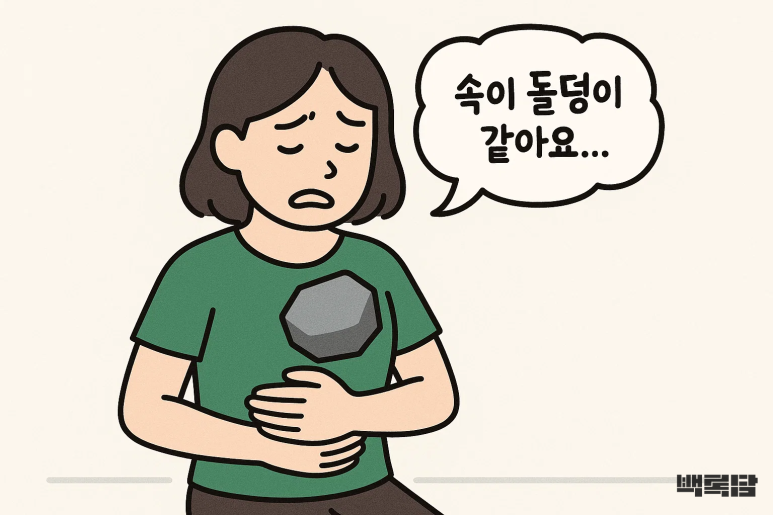
\n\n| \n “I try to reduce the amount I eat and eat healthily, but why is my digestion so poor? No matter what I eat, my stomach feels bloated and sometimes the pit of my stomach hurts. It feels like there’s a rock here.” \n |
Like this, there are surprisingly many 20-year-old female dieters who suffer from indigestion symptoms during a diet. The effort to care for the body instead harms gastric function and leads to a vicious cycle of adding to dietary maintenance and psychological burden. Is it just a problem of lack of digestive power? To be honest, I see more complex principles behind it.
Why is the stomach confused?
| \n Su-jin (pseudonym) in her mid-20s had severe stress due to job preparation and internship life. Due to a lack of confidence, she recklessly started a Low-carb High-fat (LCHF) diet. At first, it was mainly salads, but soon she extremely restricted carbohydrates with boiled eggs for breakfast, chicken breast salad for lunch, and protein shakes for dinner. Weight dropped after a month, but her stomach always felt stuffy and bloated. Pain at the end of the pit of the stomach, occasional heartburn, and severe constipation also appeared. She said she was anxious at every meal and eventually worried about whether to give up the diet. \n |
As in Su-jin’s (pseudonym) story, diet-induced digestive disorders occurring during a diet are often not just because of eating something wrong. Our stomach is also like a small ecosystem. It cannot help but be easily shaken by sudden environmental changes. Then why do indigestion symptoms occur during a diet?
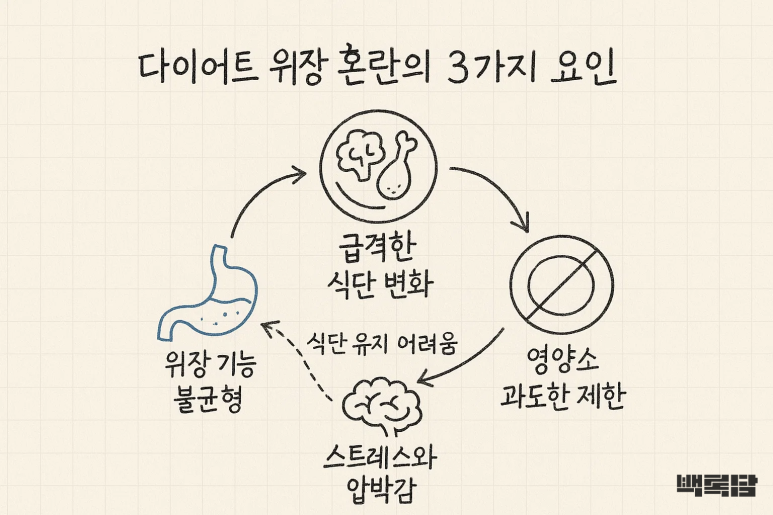
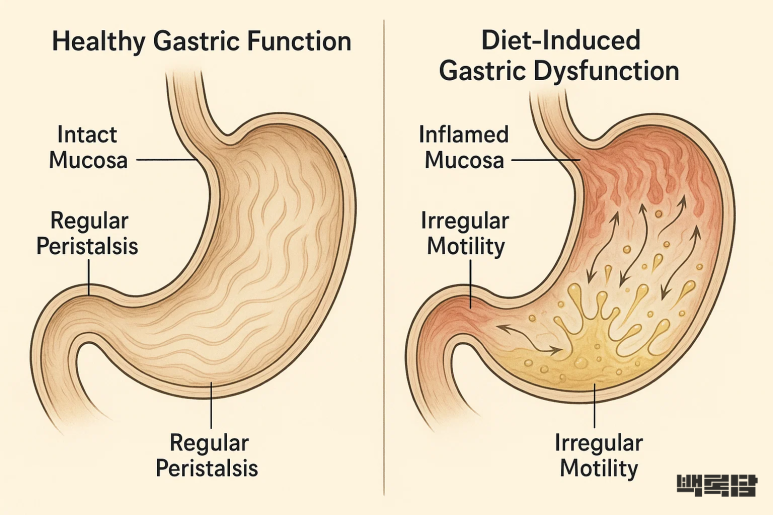
\n\n| \n In gastrointestinal function imbalance during a diet, three major factors act in complex combinations. First is rapid dietary change. The stomach needs time to adapt to different types or amounts of food than usual. Particularly, extreme carbohydrate restriction or protein-oriented diets break the balance of stomach acid secretion and digestive enzymes, slowing the digestive process and eventually causing gastrointestinal function imbalance. Second is excessive restriction of specific nutrients. If fat intake is reduced too much, bile secretion becomes difficult, making fat digestion hard, and fiber deficiency induces decreased bowel movement and constipation. Micro-nutrient deficiency essential for gastrointestinal mucosa health also brings functional decline. In this case, the stomach cannot help but be uncomfortable no matter how little you eat. Third is stress. Diet pressure, difficulty in dietary management, and impatience over weight increase cortisol levels and affect the autonomic nervous system. Stress hinders gastrointestinal peristalsis, makes stomach acid secretion irregular, and worsens the gut microbiota environment, deepening indigestion. These three factors mesh like gears to throw gastrointestinal function into confusion. You can think of the analogy where the stomach becomes like a small boat endangered in a storm. \n |
These complex factors cause imbalance in our gastrointestinal ecosystem, just like a water stream in a forest is blocked or soil dries up. You must realize that dieting is a process of matching the delicate balance of the entire body, beyond simply reducing calories. My body’s digestive system reacts much more sensitively than expected.
How to understand and care for my body’s stomach
In that case, what is the way to improve gastrointestinal disorders while continuing a healthy diet? I give practical advice that I always emphasize to patients.
First, converse with your body. Instead of chasing fad diets, you must carefully observe which foods your body feels comfortable with and which it feels uncomfortable with. Dietary control considering individual constitution and lifestyle patterns is important. The habit of eating slowly and chewing sufficiently is like correctly buttoning the first button of digestion. Excessive water intake during a meal induces stomach acid dilution, so it is good to drink 30 minutes before and after a meal. It is also a wise way to reduce the gastrointestinal burden by eating small portions often.
\n\n| \n Let’s find out how to wisely use digestive enzymes and probiotics. Sometimes external help is also good. Digestive enzymes help break down food and reduce the gastrointestinal burden. Probiotics, the key to gut health, improve the gut microbial balance and help improve indigestion and constipation. However, instead of consuming unconditionally, it is important to select a product suitable for yourself after consulting an expert. As there are various types of digestive enzyme and probiotic products on the market, weigh the ingredients and effects carefully. \n |
Caring for the mind is also essential for digestive function improvement. Find your own method for stress management. Light walking, meditation, yoga, and sufficient sleep relax the body and mind, recover autonomic nervous system balance, and are a great help in stabilizing gastrointestinal function. It is important to intentionally have a time to catch your breath for a moment, away from diet pressure. Mental comfort is transmitted directly to the stomach.
\n\n| \n You must remember the risks of extreme dietary restriction and diet side effects. Rapid calorie restriction or total exclusion of specific nutrients has a short-term weight loss effect, but in the long run, it can cause serious nutritional imbalance and gastrointestinal disorders. Total carbohydrate restriction worsens gut health by reducing dietary fiber intake, which becomes food for beneficial gut bacteria, and induces fatigue due to energy lack. Excessive protein intake can also put a burden on the kidneys. Such extreme attempts must proceed after consultation with a medical professional. Remember that a diet ignoring body signals can eventually harm health. \n |
Healthy Dieting Is a Journey of Respecting Myself
Ultimately, dieting is not just an act of losing weight. It is a process of respecting my body’s signals, listening, and finding balance. Only when the stomach is comfortable can the body and mind be healthy, and finally, can healthy weight loss goals be sustained. True health starts from a state of harmony between body and mind.
I sincerely hope you start a journey to understand yourself more deeply by listening to the small voices your body sends, rather than being bound by the scale numbers. Because the purpose of a diet goes beyond becoming more beautiful and resides in making life healthier and happier. It would be a great pleasure if I could be a small guide in this journey. I look forward to moving forward together to find a healthy way.