
“My Stomach Is So Stuffy I Have Trouble Breathing” | Saxenda Indigestion in a 30-Year-Old Dieter

Table of Contents
Saxenda, I thought it only suppressed appetite… Why does my stomach feel so bloated?
Those who are first prescribed Saxenda have high expectations for its appetite suppression and weight loss effects.
However, before long, many people say, “Director, it feels like there’s a rock sitting in my stomach.”
“It’s been about a month since I started Saxenda injections.
My weight has dropped a bit, but whenever I eat, my stomach feels stuffed as if it’s tightly blocked, and it keeps feeling bloated.
After lunch, I feel like it’s not digesting until night, and sometimes I even lose sleep because I feel nauseous.
I’m worried I might have to stop the medication.”
This indigestion is one of the common side effects that appear from the beginning of taking Saxenda.
Beyond simple discomfort, it can make one reluctant to eat at all and decrease quality of life.
Some people have such severe nausea that they cannot eat properly.
This gastrointestinal discomfort is actually closely related to the mechanism of action of Saxenda.
Ms. Park Ji-young (pseudonym), an office worker in her 30s, started taking Saxenda after worrying about weight gain after childbirth.
In the beginning, she was satisfied with the appetite suppression effect, but suffered from extreme indigestion and bloating starting from the second week.
After lunch, her stomach felt stuffy all afternoon, and she couldn’t even think about having dinner.
Due to this, nutritional imbalance was a concern, and she eventually came to deeply worry about whether to continue taking Saxenda.
Like Ms. Park Ji-young, many people experience gastrointestinal disorders while taking Saxenda.
Understanding the principle of why these symptoms appear is the beginning of management.
Why Saxenda Makes the ‘Stomach’ Slow: The Hidden Function of GLP-1 Analogues
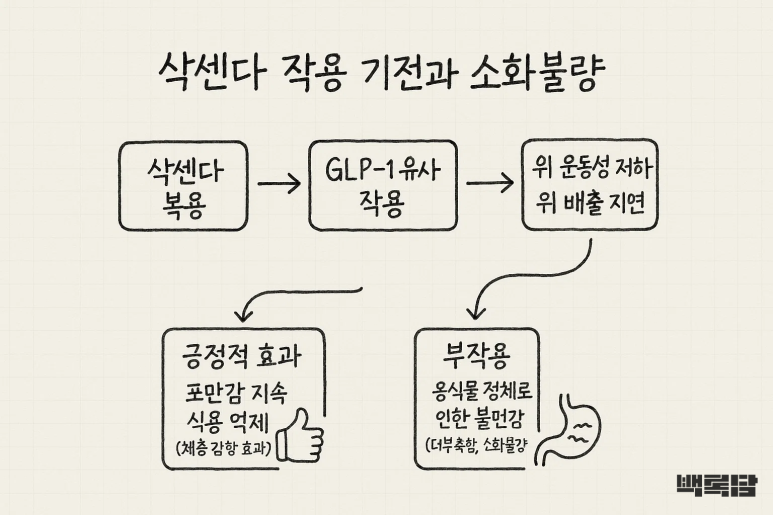
Saxenda is an appetite suppressant with the liraglutide component that acts similarly to a hormone in our body called GLP-1 (Glucagon-Like Peptide-1).
This GLP-1 promotes insulin secretion from the pancreas and inhibits glucagon secretion to regulate blood sugar.
At the same time, it acts on the hypothalamus of the brain to play an important role in increasing satiety and reducing appetite.
However, GLP-1 also affects gastrointestinal motility in our body.
It is through a function called ‘gastric emptying delay.’
Taking Saxenda → GLP-1 analogue action → Decreased stomach motility and gastric emptying delay → Increased time food stays in the stomach → Sustained satiety and appetite suppression (Positive effect)
But simultaneously, discomfort due to food stagnation occurs → Gastrointestinal disorders such as bloating, nausea, and indigestion (Side effect)
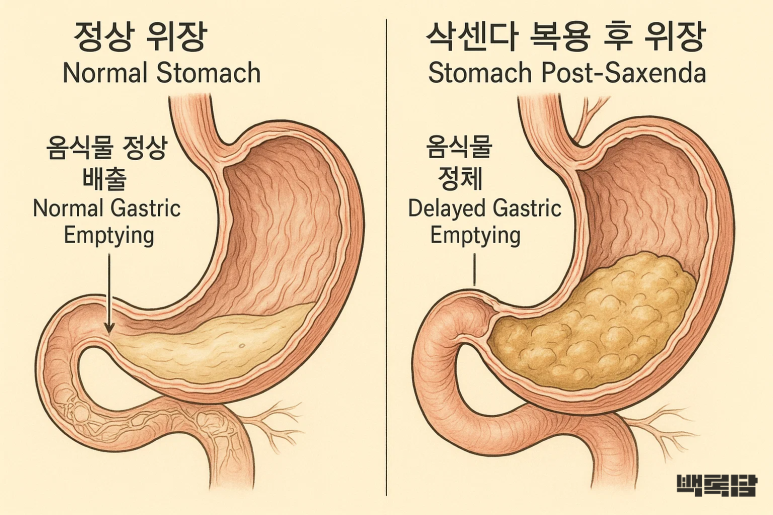
When Saxenda slows down the gastric emptying rate, food stays in the stomach for longer.
As an advantage, this helps with weight loss by making one feel full even with a small amount, but as a disadvantage, it causes digestion to feel slow, the stomach to feel bloated, and induces nausea.
Our body needs time to adapt to environmental changes.
In the early stages of taking Saxenda, the body is often not used to these changes, so indigestion symptoms appear prominently.
Indigestion: It Must Be Handled Delicately Like This: My Own Recovery Strategy
Indigestion from taking Saxenda can be managed with various management methods besides simply enduring it or stopping the medication.
What I emphasize to patients in the clinic is exactly ‘a delicate approach suitable for the body’s state.’
It is important to respond without missing the small signals the body sends.
Improving lifestyle habits is important for alleviating indigestion. Reduce meal portions and I recommend eating small portions many times, dividing it into four or five times a day rather than three. Establishing the habit of chewing food slowly and thoroughly can effectively reduce the digestive burden. It is good to avoid foods with high fat content, fried foods, or irritating foods that are too spicy or salty. Instead, consume balanced nutrition with a diet focused on fresh vegetables and protein. After eating, do not lie down immediately; moving the body with a light walk, etc., helps with digestion. Sufficient water intake is also important, so try to establish a habit of drinking water often.
Also, Saxenda dosage adjustment can also be considered.
If gastrointestinal symptoms are too severe, it is wise to temporarily lower the dose or adjust the timing when an increase is needed.
These measures must be carried out in consultation with a medical professional.
Wise Companion for Healthy Weight Loss: Things Not to Miss

Weight loss through Saxenda should aim for overall health promotion, beyond simple changes in the scale numbers.
If the body is having a hard time due to side effects like indigestion, it is difficult to see this as sustainable healthy loss.
If indigestion symptoms are so severe that daily life is difficult, or if other abnormal symptoms such as vomiting, abdominal pain, or fever are accompanied, you must consult a medical professional.
Do not stop taking the medicine or adjust the dose with a hasty judgment, but get help from an expert for accurate diagnosis and appropriate response.
Particularly, there is a possibility of serious complications such as cholecystitis or pancreatitis, so you must be extra cautious.
I often combine herbal treatments to alleviate gastrointestinal symptoms and reclaim the body’s balance for patients taking Saxenda, not just prescribing medicine.
Looking at the entire body and putting effort into improving overall lifestyle habits such as stress or sleep patterns is the key to healthy weight loss.
I hope you listen to your body and manage it wisely so that the journey with Saxenda can be a bit more comfortable and sustainable.
Even if it isn’t me, I sincerely encourage you to find a medical companion who looks at the entire body and make them a partner in your recovery.
Because the balance of a healthy life is precious.