“My Stomach Feels Bloated Whenever I Eat Meat” | Protein Indigestion in a 50-Year-Old Man

Table of Contents
Why does protein digestion become harder as we age?
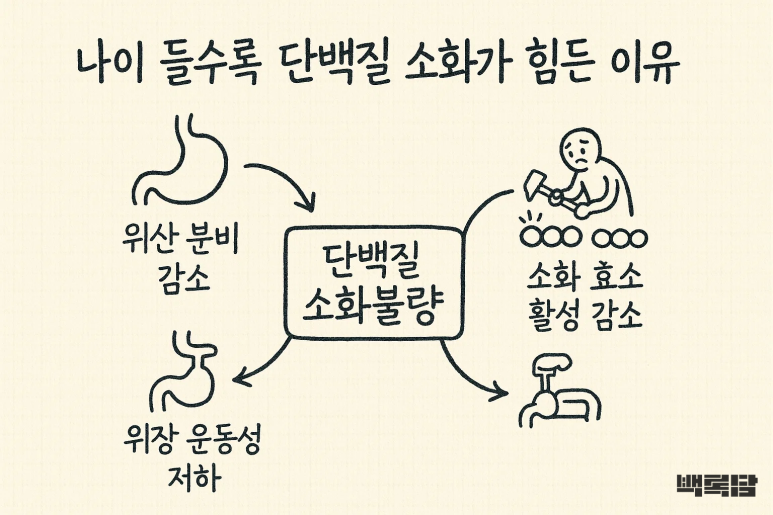
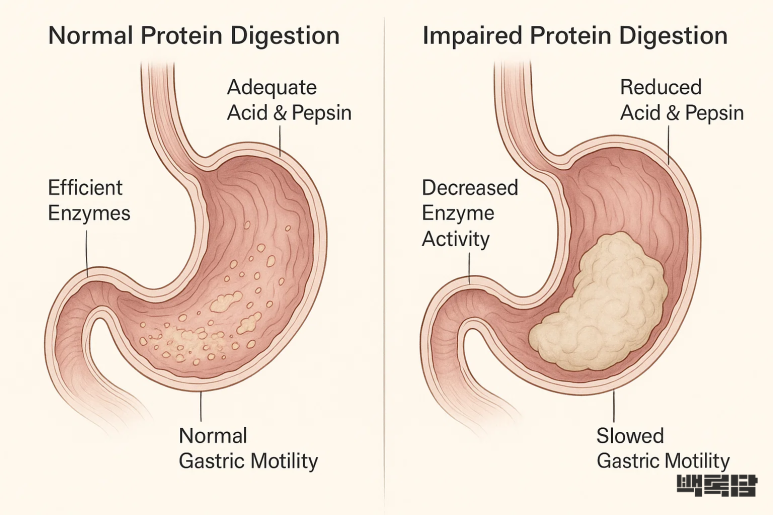
Protein builds important components of our bodies such as muscles, immune cells, and enzymes. To properly digest and absorb such protein, sufficient secretion of digestive enzymes like stomach acid and pepsin is essential. However, various changes occur in this process as we age.
First, stomach acid secretion decreases. Stomach acid denatures protein to make it easier for digestive enzymes to act, and plays a role in converting pepsinogen into active pepsin. When stomach acid is insufficient, protein is not sufficiently broken down and stays in the stomach for a long time, causing bloating.
Second, digestive enzyme activity decreases. Particularly, the secretion or activity of protein-degrading enzymes secreted by the pancreas, such as trypsin and chymotrypsin, can decrease.
\n\n| \n Digestive enzymes are like ‘workers’ in our bodies. Key enzymes for protein digestion include pepsin secreted in the stomach, and trypsin, chymotrypsin secreted in the pancreas. If these enzymes are not sufficient, it is difficult to fully make those nutrients your own, no matter how good the protein you consume is. \n |
Third, gastrointestinal motility decreases. The stomach acts as a pump that breaks down protein masses finely and moves them to the small intestine. As we age, this gastrointestinal motility drops, so protein stays in the stomach longer, leading to a feeling of bloating and indigestion.
These three factors are changes that can naturally appear with increasing age and become the core principles of protein indigestion.
It’s Not Just a Problem of Aging: Stress and Lifestyle Habits
Not everyone suffering from protein indigestion is old or has serious problems with their digestive organs. Rather, stress and irregular lifestyle habits often worsen digestive function further.
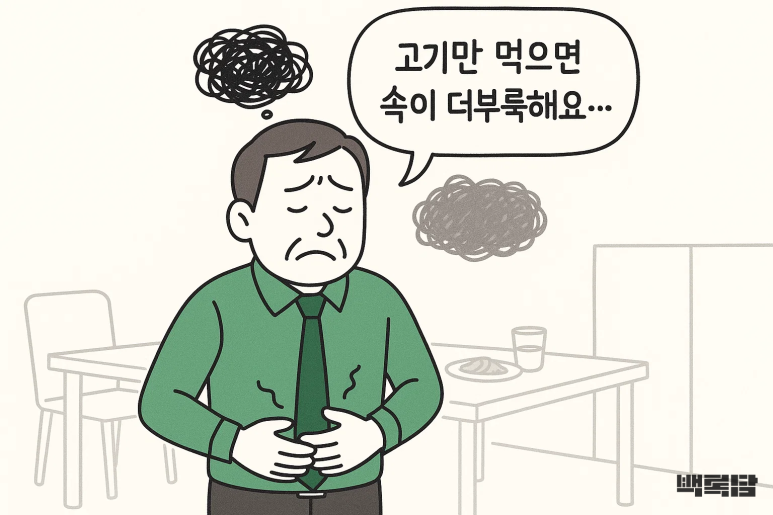
\n\n| \n Kim Min-jun (pseudonym) is an office worker in his early 50s. He said for a few months now, he uniquely has indigestion if he eats meat, and in severe cases, felt pain in the pit of his stomach. There were no special abnormalities in his health checkup, but he was suffering from chronic fatigue and tension due to high-stress work and frequent overtime. “If I eat a chicken breast salad at lunch, my stomach feels stuffy all afternoon so it’s hard to focus on work. I have to eat meat with my family in the evening, but I feel sorry because I’m afraid I’ll ruin the meal atmosphere because I feel burdened.” Kim Min-jun was a typical case where gastrointestinal motility and digestive enzyme secretion were further inhibited as his autonomic nervous system balance was broken due to stress. \n |
Stress directly affects the autonomic nervous system. When stressed, sympathetic nerves are promoted, reducing blood flow to the digestive system, and digestive enzyme secretion and gastrointestinal motility are inhibited. Eating quickly in a busy and tense daily life or having irregular meal times also puts a great burden on the digestive organs.
Ultimately, this creates synergy with the natural decline in digestive function that occurs with age, becoming the main culprit that deepens protein indigestion.
Customized Strategy for Healthy Protein Intake and Strengthening Digestive Function
In that case, how can these problems be solved? The practical solutions I brainstorm together with patients in the clinic are as follows.
\n\n| \n The core pathway for improving protein digestion is as follows. First, avoid consuming a large amount of protein at once and divide it over several meals to reduce the digestive burden. Second, choose boiling or steaming cooking methods rather than frying or grilling to put less burden on digestion. Third, efforts are needed to chew food sufficiently to break it down finely, widening the surface area on which digestive enzymes can act. Fourth, it is important to reduce stress and eat slowly in a comfortable environment. Finally, if necessary, you can assist digestive function by considering digestive enzyme supplements or combining herbal treatments helpful for digestion. \n |
Most importantly, regulating protein intake amount and speed is important. Instead of consuming a large amount of protein at once, consuming small amounts divided over several meals eases the burden on the body. Abandoning the habit of eating quickly and chewing sufficiently before swallowing is also an essential effort. Along with this, you should choose protein foods that are easy to digest and pay attention to cooking methods. It is good to appropriately combine parts of meat with less digestive burden, fish, tofu, eggs, and other plant proteins, and boiling or steaming is much more advantageous for digestion than frying or grilling.
To improve protein indigestion, efforts to strengthen overall digestive function are needed beyond simply changing the diet. Stress management is very important for digestive function recovery. It is good to establish habits for relieving stress through meditation, light exercise, and sufficient rest. Also, consistently consuming traditional ingredients or fermented foods that increase gastrointestinal motility and help digestive enzyme secretion to assist digestive function, such as plum, ginger tea, and soybean paste, can be helpful. If symptoms are severe or chronic, you can consider herbal treatment suitable for an individual’s constitution and symptoms. This can help fundamentally improve the body’s digestive environment beyond simply suppressing symptoms. I also provide customized prescriptions in the clinic by comprehensively considering a patient’s gastrointestinal state and general condition.
\n\n| \n If protein indigestion symptoms persist, or if serious symptoms such as weight loss, bloody stool, or vomiting are accompanied, you must visit a medical institution to receive accurate diagnosis and treatment. Self-diagnosis or self-treatment can instead worsen symptoms or miss signals of important diseases. \n |
The Journey to Reclaiming Our Body’s Digestive Power
Protein indigestion can be part of natural physical changes that can come to anyone. However, if you do not dismiss it as a simple discomfort but understand it as a subtle signal your body is sending and cope with it actively, it can be sufficiently improved.
\n\n| \n Even in the classic medical text 『Donguibogam (동의보감)』, the importance of digestive function is emphasized, stating: “Sik-sang (식상, 食傷) is a disease caused by being hurt by food, because the Spleen and Stomach (脾胃) are weak and cannot digest food.” This is an insight that aligns with decreased digestive enzyme secretion and gastrointestinal motility reduction mentioned in modern medicine. \n |
I hope to be a small companion in the journey to find appropriate solutions by listening to your body so that protein intake can become the joy of reclaiming healthy life vitality beyond simply filling nutrients.