
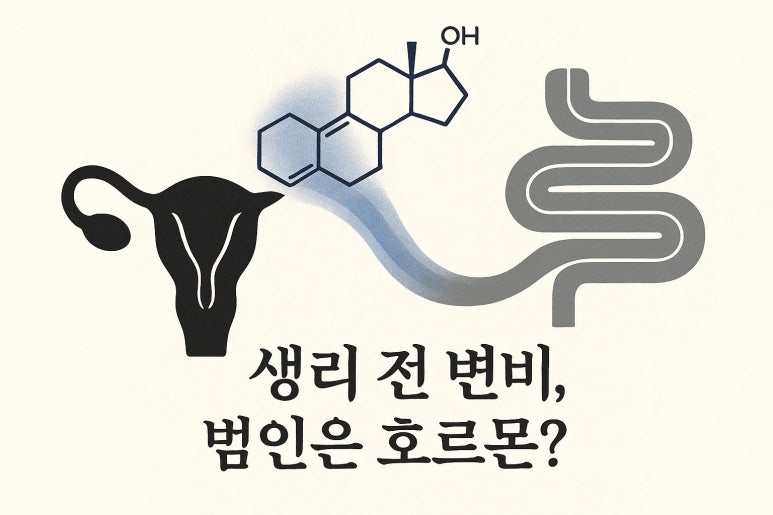
Why Do I Get Constipated Only During My Period? | Incheon Constipation

Why Does Constipation Only Occur During My Period When I'm Usually Fine?
| "It's truly fascinating. Exactly one week before my period starts, my lower abdomen feels heavy, and it becomes difficult to go to the bathroom. Then, once my period begins, it's as if nothing ever happened, and I feel fine again." |
Many women experience discomfort from constipation that recurs only at specific times, known as cyclical constipation. Despite no significant changes in diet or lifestyle, they feel as though their bowels stop specifically before menstruation.
This isn't because your bowels are lazy, but rather a natural result of our body's sophisticated hormonal system at work.
| [Counter-Evidence] If the problem were caused by a specific food you don't normally eat, constipation shouldn't occur when you avoid that food. However, if constipation recurs around the same time every month without an apparent external cause, we must look for the culprit within the body. That culprit is the hormone 'progesterone'. |
Progesterone is like a 'special agent for maintaining pregnancy'. This hormone's primary mission is to maintain the uterus in a stable state, creating an environment where a fertilized egg can safely implant and grow. To achieve this, progesterone relaxes the uterine muscles (smooth muscle) to prevent unnecessary contractions.
The problem is that this special agent's command is so powerful that it affects not only the uterus but also other organs with similar structures. Our large intestine's walls are also composed of smooth muscle, similar to the uterus.
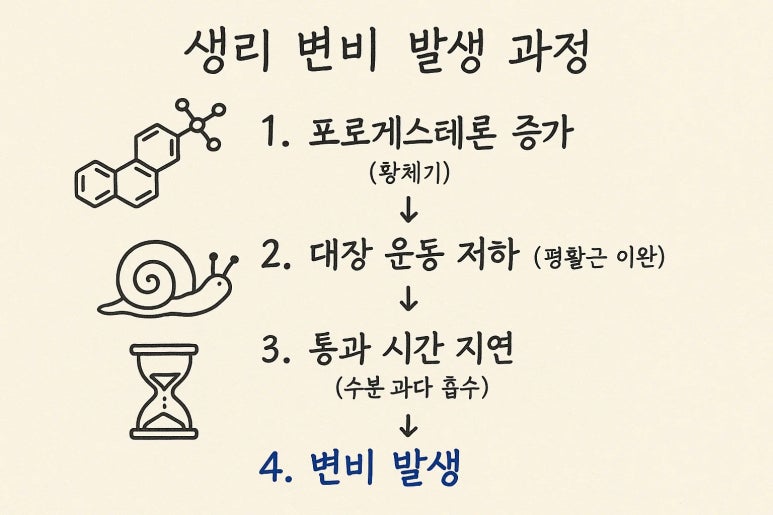
| [CASE] If there's a woman whose `period constipation` pattern begins approximately one week after ovulation, this precisely coincides with the period when progesterone levels reach their peak. |
The period from the end of ovulation until the start of menstruation is called the 'luteal phase,' and during this time, progesterone levels rapidly increase. When the power of this hormone, which relaxes the uterus, is transmitted to the large intestine, the large intestine's peristaltic movement—that is, the force of the intestines contracting and pushing contents forward—
weakens. This is a key reason why `progesterone constipation` occurs.
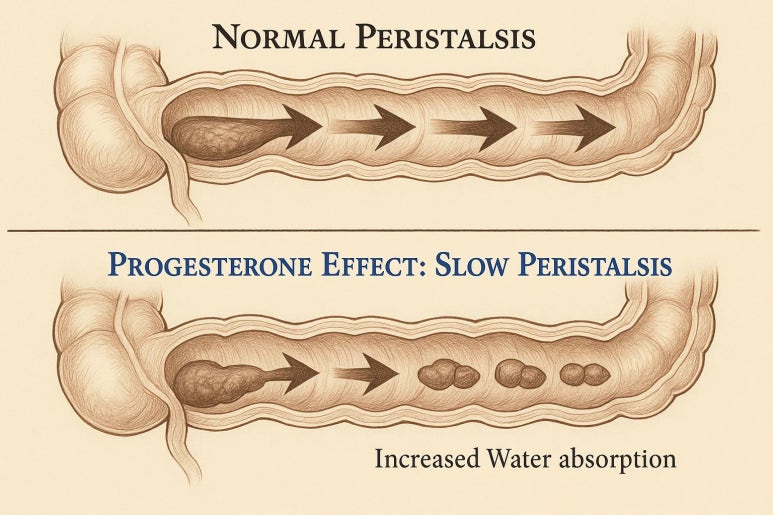
Ovulation followed by luteal phase onset → Rapid increase in progesterone levels → Slowdown of large intestinal peristalsis → Delayed passage time of food through intestines → Increased water absorption time → Stool hardens → Constipation occurs.
When the intestines move slowly, food residue stays in the intestines for longer, and during this time, the large intestine absorbs more water than necessary. Consequently, the stool becomes increasingly harder and drier, initiating a vicious cycle where evacuation becomes difficult. This is precisely why `luteal phase symptoms` often include complaints of lower abdominal bloating and discomfort.
| [Note: Traditional Korean Medicine Perspective] In Traditional Korean Medicine, this phenomenon is sometimes explained from the perspective of 'Qi stagnation (氣滯)'. If the overall circulation of Qi (氣) in the body is blocked due to stress or hormonal changes, the excretory function (傳導功能) of the internal organs is impaired, making it unable to properly push out contents. This aligns with the modern medical interpretation that specific hormones directly affect intestinal motor function. |
| [Coping Strategies] So, must we simply endure this monthly recurring discomfort? If the cause lies with hormones, we can find wise ways to 'assist the slowed intestines' in accordance with the hormone's fluctuating cycle. Before relying on laxatives like Magmil, it's advisable to proactively incorporate `constipation-friendly foods` rich in dietary fiber (e.g., prunes, avocados, whole grains) along with adequate hydration. Additionally, supplementing with nutrients that utilize the `benefits of magnesium` for muscle relaxation can also be a strategy. |