
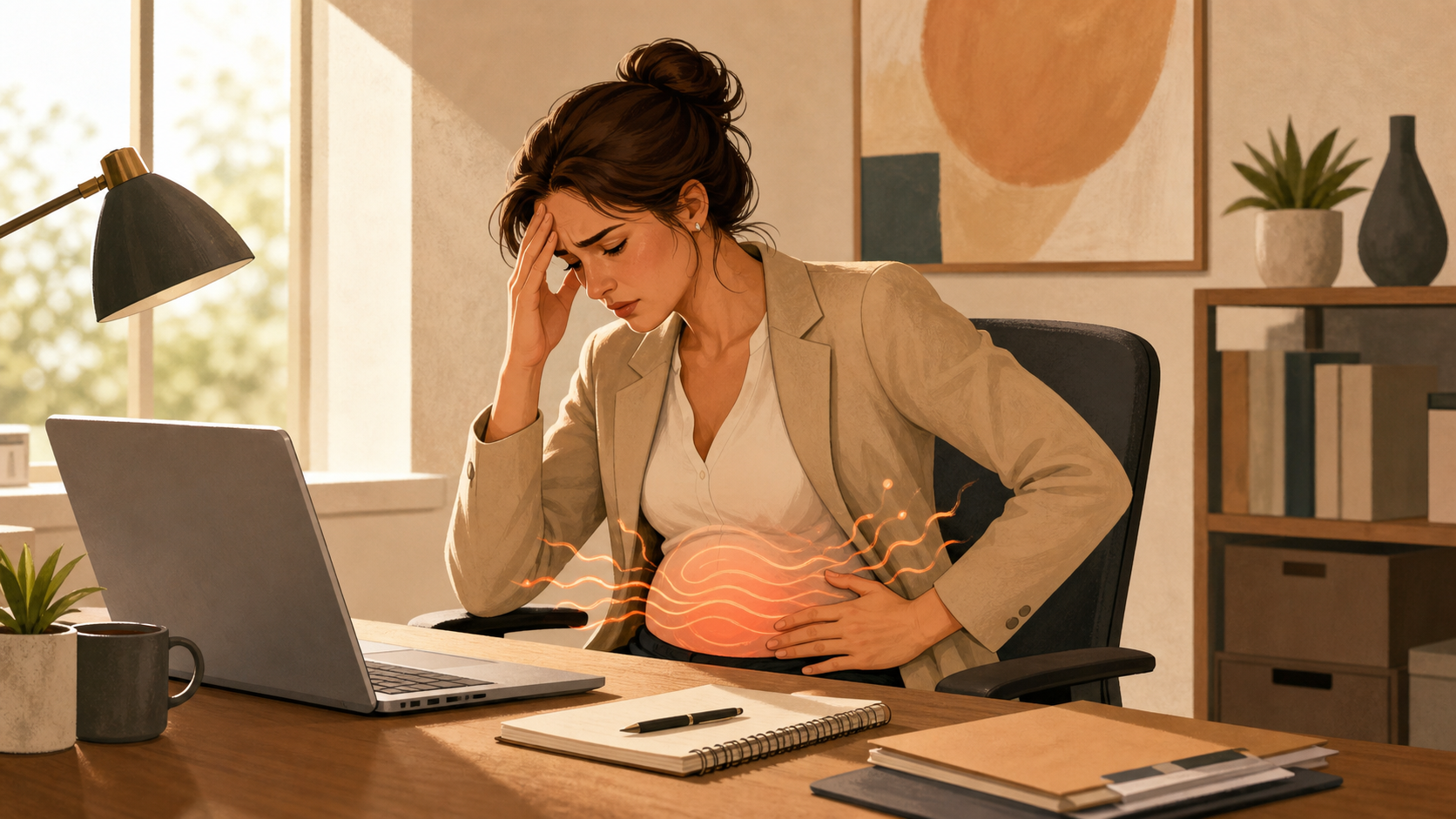
Why Stress Makes You Gain Weight - Cortisol and Abdominal Obesity Explained by a Korean Medicine Doctor

Table of Contents
Why Does Stress Target Just the Belly?
I have been exercising and eating less, but my belly just keeps growing. That is what Ms. Park (45, pseudonym) said when she first came in.
At 162cm and 67kg the numbers suggest overweight, but what bothered her more was her waistline. Her arms and legs looked fine, yet her abdomen protruded noticeably.
It does not feel like gaining weight overall. More like my belly is expanding. And it gets worse when I am stressed.
The moment I heard that, I thought: Cortisol.
Cortisol: The Stress Hormone That Builds Belly Fat
Cortisol is a hormone secreted by the adrenal glands, small organs sitting on top of your kidneys. It puts your body into an alert state so you can respond quickly to perceived danger or pressure.
The problem is modern chronic stress. Deadlines, office politics, endless messages. Your body interprets all of these as danger signals, causing cortisol to trickle out all day long.
When cortisol stays chronically elevated, two things happen. First, visceral fat accumulates faster. Cortisol binds preferentially to fat cell receptors concentrated around the abdomen, signaling the body to store energy there first. Second, appetite rises. Cortisol stimulates ghrelin (the hunger hormone) and blunts leptin (the satiety hormone), making it hard to feel full.
That is why the belly grows while the rest of the body stays the same. The mechanism is fundamentally different from obesity caused simply by overeating.
Korean Medicine: Liver Qi Stagnation and Spleen Deficiency
In Korean medicine, stress-related abdominal obesity is typically understood as Gan Yu Pi Xu (肝鬱脾虛), liver qi stagnation suppressing spleen function. Stress knots the liver energy flow, which compresses the spleen ability to digest and transform food.
When the spleen weakens, food fails to convert into energy and instead accumulates as Dampness-Phlegm (濕痰), a pathological byproduct of stagnant fluids and metabolic waste that tends to settle in the abdomen.
Ms. Park fit this pattern exactly: frequent bloating, persistent fatigue, slightly cold hands and feet, cravings for sweets and salty foods. Stress to liver stagnation to spleen deficiency to abdominal dampness. Textbook.
How We Approached It with Baekrokgambijeong
I prescribed Baekrokgambijeong, a standardized herbal tablet delivering the same efficacy as a traditional decoction, containing Ephedra among its compound formula.
Some patients worry about Ephedra, but we manage it safely through dosage design. For someone as sensitive as Ms. Park, we started at 1 tablet and titrated up to 2 based on her response. That is personalization through dosing design, not changing the formula but adjusting the amount and timing to fit the individual.
The routine itself matters too. Taking tablets at fixed times creates a daily rhythm. Thirty minutes before meals naturally moderates food intake, and the act becomes a behavioral cue. The pharmacological effect and the behavioral intervention work together.
Ms. Park After Three Months
Three months later, Ms. Park had lost 5.3kg. More telling than the number was: My old pants fit again at the waist. Meaning the reduction was centered on the abdomen.
Her stress did not disappear. Work was still busy, deadlines still came. But the twice-daily routine became a moment of self-care, and that gradually reshaped her eating habits as a whole.
FAQ
Q. If I cannot eliminate stress, can I still lose weight?
Removing the source is ideal but rarely realistic. Korean medicine focuses on normalizing the body reaction pattern (liver-spleen imbalance) rather than the stress itself, making the body less reactive even when stress remains.
Q. Is cardio not the most effective approach for abdominal fat?
Cardio definitely helps. However, when cortisol is chronically high, high-intensity exercise can raise cortisol further and backfire. Low-intensity steady exercise combined with herbal medicine to rebalance hormones often works better.
Q. Can I drink coffee while taking Baekrokgambijeong?
Because Ephedra has a mild stimulating effect, we recommend avoiding overlap with caffeine in the late afternoon. Typically we schedule morning and midday doses, keeping evening intake before 6 PM. Most patients report no sleep disturbance with this timing.