
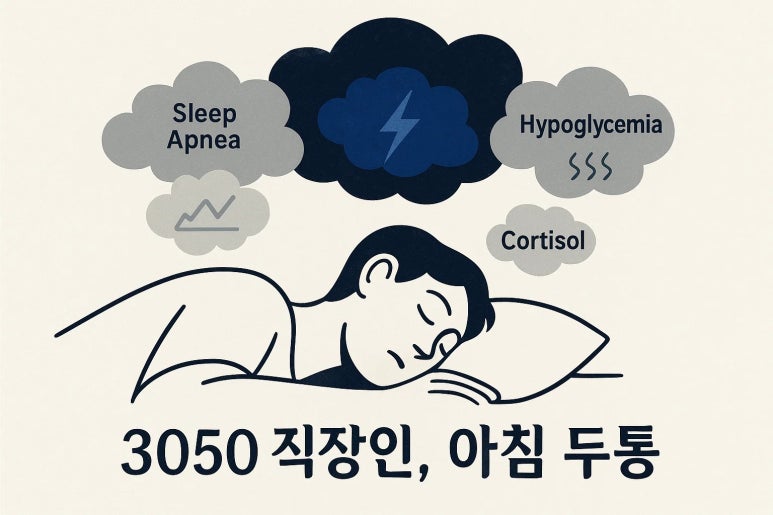
Why Your Head Still Hurts Every Morning After 8 Hours of Sleep | Incheon Morning Headache

The Real Reason Your Head Aches Every Morning, Even After 8 Hours of Sleep
| "I'm sure I slept soundly for over 8 hours, but when I wake up in the morning, my head feels like it's splitting. Strangely, after I go to work, have a cup of coffee, and get caught up in tasks, it gets better by the afternoon." |
Many office workers report similar experiences: a paradoxical situation where they start their morning with a headache despite getting enough rest. We often attribute this to simple fatigue, but if the symptoms persist even after increasing sleep duration, the root of the problem might lie elsewhere.
| [Clues to Pay Attention To] It's not a matter of sleep 'quantity' but 'quality', and furthermore, it could be a sign of an invisible 'battle' occurring within our bodies during sleep. |
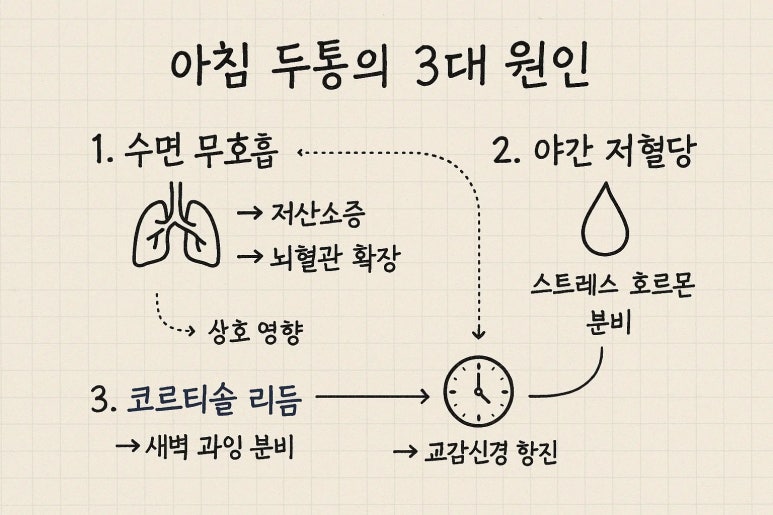
The first suspect we should consider is 'sleep apnea'.
| [CASE STUDY] Mr. L, a sales team leader in his mid-40s, reported chronic fatigue and morning headaches as his primary symptoms. He was aware that he snored heavily but had not considered it a cause of his headaches. A polysomnography revealed he was diagnosed with moderate sleep apnea, experiencing more than 20 episodes of breathing cessation per hour during sleep. |
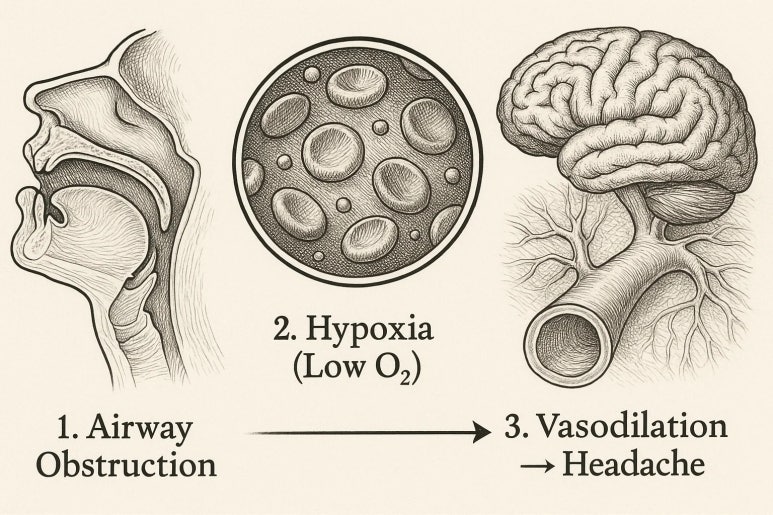
When breathing stops during sleep, the body falls into a state of hypoxia due to insufficient oxygen supply. In severe cases, blood oxygen saturation can drop below 90%. To compensate for the lack of oxygen, our brain forcibly dilates blood vessels, and it is this process that causes pressure on the nerves around the blood vessels, leading to morning headaches. This is akin to 'the surrounding walls shaking when a fire truck suddenly tries to pass through a narrow alleyway'.
The second suspect is 'nocturnal hypoglycemia'.
| "Strangely, I always wake up around 4-5 AM. And if I find it hard to fall back asleep, my head aches much more the next morning." |
This could be a crucial clue indicating a problem with your blood sugar regulation system. Especially, having a poor dinner or consuming refined carbohydrates (snacks, bread, soft drinks) just before bed can trigger a 'blood sugar rollercoaster' that rapidly raises and then drops blood sugar, increasing the risk of nocturnal hypoglycemia.
If blood sugar levels drop too low during sleep, our body releases stress hormones like cortisol and adrenaline to raise blood sugar, for survival. This process rapidly stimulates the sympathetic nervous system, constricting cerebral blood vessels and tensing muscles, thereby causing headaches. Furthermore, these hormones disrupt sleep and can cause you to wake up. Many people who complain of `headaches after waking up` fall into this category.
The final suspect is an issue with the secretion rhythm of the stress hormone 'cortisol' itself. Cortisol is a 'waking hormone' that helps us wake up in the morning and start the day energetically. Healthy individuals typically show a pattern where cortisol levels peak in the morning and then gradually decline. However, in cases of chronic stress, this rhythm can be disrupted, leading to excessive cortisol secretion in the early hours of the morning. Excessive overtime and accumulated stress → Abnormal increase in cortisol secretion time/amount in the early morning → Waking up in a state of sympathetic nervous system overactivity → Increased blood pressure and cerebral vascular pressure → Morning headache occurs.
Ultimately, the `cause of morning headaches` is not simple. It's often a complex interplay of respiratory issues suspected of `sleep apnea headaches`, metabolic issues related to `nocturnal hypoglycemia symptoms`, and hormonal problems due to stress.
| [Note: Traditional Korean Medicine Perspective] In Traditional Korean Medicine (TKM), this is sometimes explained by the concept of 'Damgweol-dootong (Phlegm-Reversal Headache)'. It suggests that stress and poor eating habits lead to the stagnation of abnormal bodily fluids called 'dameum (phlegm-fluid)' within the body, and this obstructs the clear energy from ascending to the head, thereby causing headaches. This aligns with modern interpretations where microcirculation in the brain is impaired due to hypoxia or blood sugar issues. |
| [Shift in Perspective] So, how should we untangle this complex web of headaches? Considering `ways to improve sleep quality` and finding `methods to lower cortisol levels` can be a more fundamental solution than simply taking painkillers. This is the first step in shifting our perspective from 'pain' to 'stabilizing the body during sleep'. |